7.12 Origins of Life on Earth
Scientists explain life's origin as a gradual chemical process on the early Earth. Experiments show how simple molecules could have formed and how RNA may have come before DNA.
The early Earth
Earth formed about 4.6 billion years ago. For its first several hundred million years, it was very hot and heavily bombarded by space rocks. As it cooled, oceans formed. The oldest fossils of cells, in the form of layered rock structures and tiny fossils, date to about 3.5 billion years ago, and there is chemical evidence for life that may be even older. Life is therefore very old, and for most of Earth's history, only single-celled organisms existed.
The early atmosphere had very little free oxygen. It probably contained gases such as water vapor, carbon dioxide, nitrogen and others from volcanoes. Oxygen began to build up only after photosynthetic bacteria, similar to modern cyanobacteria, evolved and released it, about 2.4 billion years ago. This rise of oxygen changed the planet, killing many anaerobic organisms and allowing aerobic respiration to evolve.
The question of how life began is difficult because the events happened so long ago, and so scientists build models and test them in the laboratory.
From simple molecules to the building blocks
The first step in many models is the formation of organic molecules from inorganic ones, a process called abiotic synthesis. In 1953, Stanley Miller and Harold Urey tested this idea. They built an apparatus that held water and a mixture of gases thought at the time to be like the early atmosphere, and passed electric sparks through it to imitate lightning. After a few days, the water contained several amino acids and other organic molecules.
Later work suggests that the early atmosphere may have been different from the mixture they used, but similar experiments with other gas mixtures also produce organic molecules. Scientists also find amino acids in meteorites, so organic molecules may also have come from space. Other settings, such as hot vents on the ocean floor and volcanic regions, have also been proposed as sites where organic molecules formed.
From molecules to cells
The next step is the joining of small molecules into polymers. Experiments show that amino acids and nucleotides can link into short chains when dripped onto hot sand, clay or rock, which may have provided surfaces to help the reactions. The polymers had to be enclosed in some kind of boundary. Scientists have shown that lipids in water spontaneously form closed spheres called protocells or liposomes, a link to what you learned about phospholipids in 1.5. These can take in molecules, grow and sometimes divide.
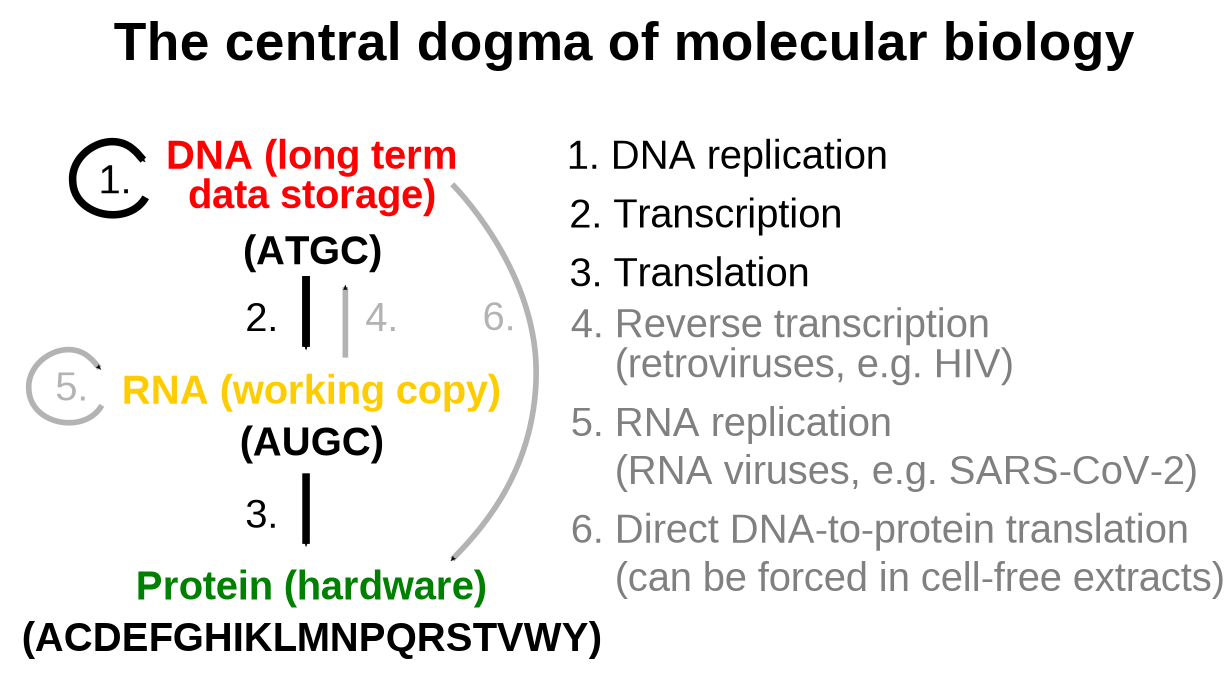
Some models suggest that the first genetic molecule was RNA, not DNA. This is the RNA world hypothesis. RNA can store information in its sequence and, as in ribozymes, it can also act as an enzyme to catalyze reactions, including the copying of other RNA. DNA is more stable and a better store of information, while proteins are better catalysts, so over time they would have taken over those roles, leaving RNA as the go-between. The fact that ribosomes use RNA to join amino acids is consistent with this idea.
What we know and what we do not
Scientists are confident that early life was prokaryotic, that organic molecules form easily under early Earth conditions and that RNA can act as both information and enzyme. They do not know exactly where or how the first cell formed, and there is not yet one accepted model. This is a normal state of science. Open questions guide new experiments.
- Abiotic synthesis: organic molecules form from inorganic ones, as in the Miller-Urey experiment.
- Protocells: lipid spheres that enclose molecules.
- RNA world: RNA may have stored information and acted as an enzyme.
- Oxygen: built up after photosynthetic bacteria evolved.
- Evidence: very old fossils and chemical traces show that life is ancient.
Worked example: judging an origin-of-life experiment
In a Miller-Urey type experiment, a flask holds water and gases, and electric sparks are passed through it for a week. The water turns brown and tests show that amino acids are present. Evaluate the claim that this shows life began from simple chemicals. The experiment shows that important building blocks of life can form from simple molecules and energy, which supports the first step of the model.
It does not show that cells formed, or how molecules came together to copy themselves. It also depends on the gases chosen, and later research suggests that the early atmosphere might have been different from the original mix. A balanced answer states what the experiment shows, what it leaves open and how other evidence, such as amino acids in meteorites, supports the claim. This kind of careful evaluation is what the exam wants.
Why it matters for the exam
Typical questions describe the Miller-Urey apparatus and ask what it tested and what it showed, or ask why RNA might have come before DNA. Give the claim, the evidence and the reasoning. State that the experiment showed that amino acids can form from simple molecules under the conditions modeled, but did not show how life itself began.
This topic completes Unit 7. Unit 8 moves from the history of life to how organisms interact with each other and with their environment today.
Key takeaways
- Earth is about 4.6 billion years old, and the oldest cell fossils are about 3.5 billion years old.
- The early atmosphere had little free oxygen.
- Miller and Urey showed organic molecules can form from simple gases and energy.
- Lipids spontaneously form protocells.
- The RNA world hypothesis says RNA came before DNA and protein.
- Photosynthetic bacteria raised oxygen levels.
- How life began is still being investigated.
How this shows up on the exam
- Multiple choice: state what the Miller-Urey experiment showed.
- Short answer: explain the RNA world hypothesis.
- Reasoning skill: judge the strength of evidence.
- Data question: timeline of Earth and life.
Common mistakes
- Saying Miller and Urey created life. They made organic molecules.
- Saying early Earth had a lot of oxygen. It had very little.
- Saying DNA came before RNA in the RNA world idea. RNA came first.
- Saying scientists know exactly how life began. It is an open question.
Key terms
- abiotic synthesis
- Miller-Urey experiment
- protocell
- RNA world hypothesis
- ribozyme
- early atmosphere
- cyanobacteria
- oxygen
- liposome
Check yourself
Topic 7.12 quiz
What does the RNA world hypothesis propose?