8.2 Energy Flow Through Ecosystems
Energy enters ecosystems as sunlight and flows one way through food chains and webs. At each step most of it is lost as heat, while matter is recycled.
Producers, consumers and decomposers
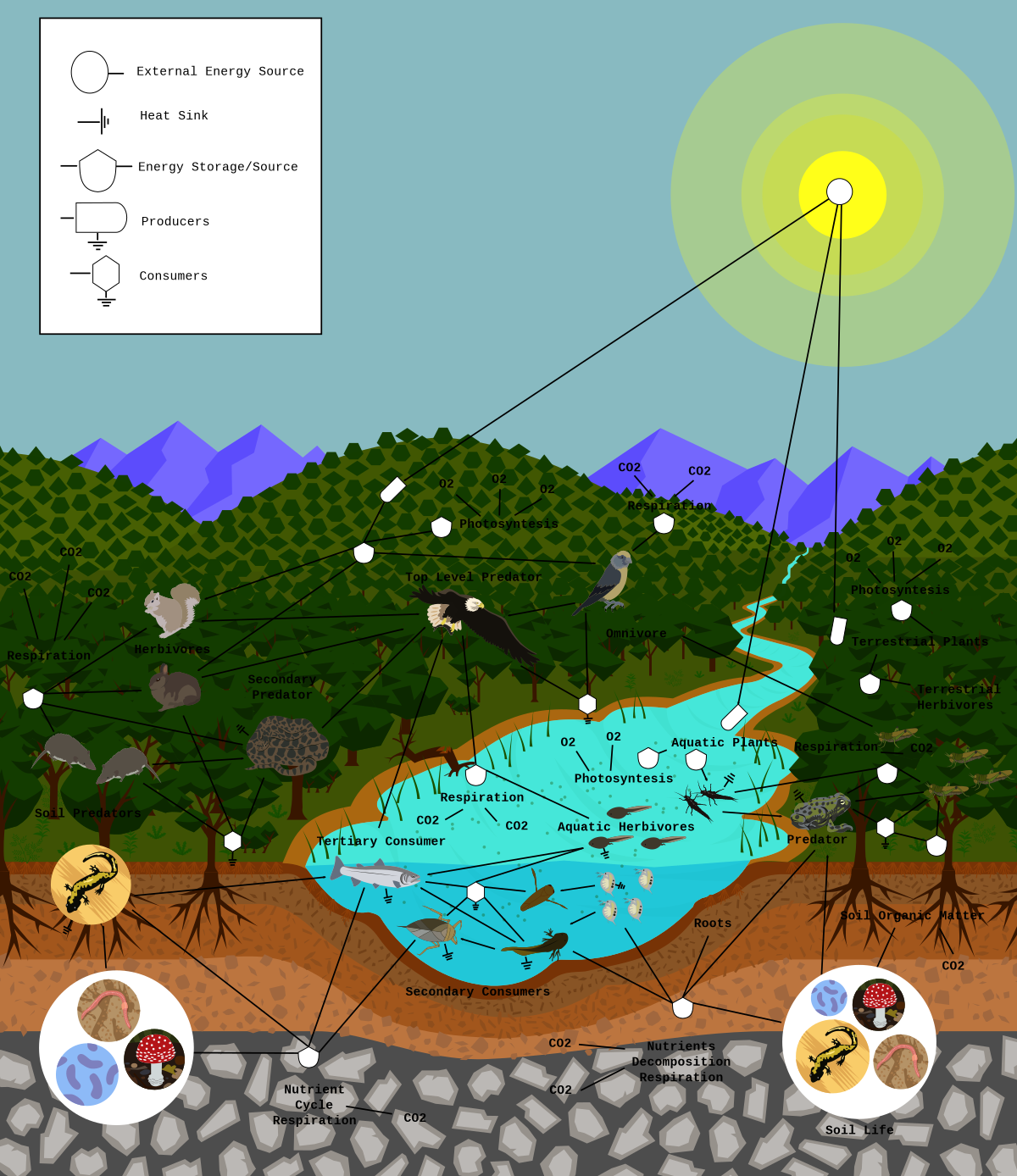
An ecosystem is all the living things in an area together with the nonliving parts of the environment. Energy enters almost all ecosystems as sunlight. Producers, or autotrophs, use photosynthesis to turn it into chemical energy in sugars, as in 3.4. In some places, such as deep-sea vents, bacteria produce food by chemosynthesis, using energy from chemicals like hydrogen sulfide.
Consumers, or heterotrophs, get energy by eating other organisms. Primary consumers eat producers, secondary consumers eat primary consumers and tertiary consumers eat secondary consumers. Each feeding level is a trophic level. Decomposers, such as bacteria and fungi, break down dead organisms and wastes, and release nutrients back to the soil. Without them, nutrients would stay locked in dead matter.
A food chain shows one path of energy, and a food web shows many connected chains. A web is a more realistic picture, because most animals eat several kinds of food and are eaten by several predators.
Energy transfer and the 10 percent rule
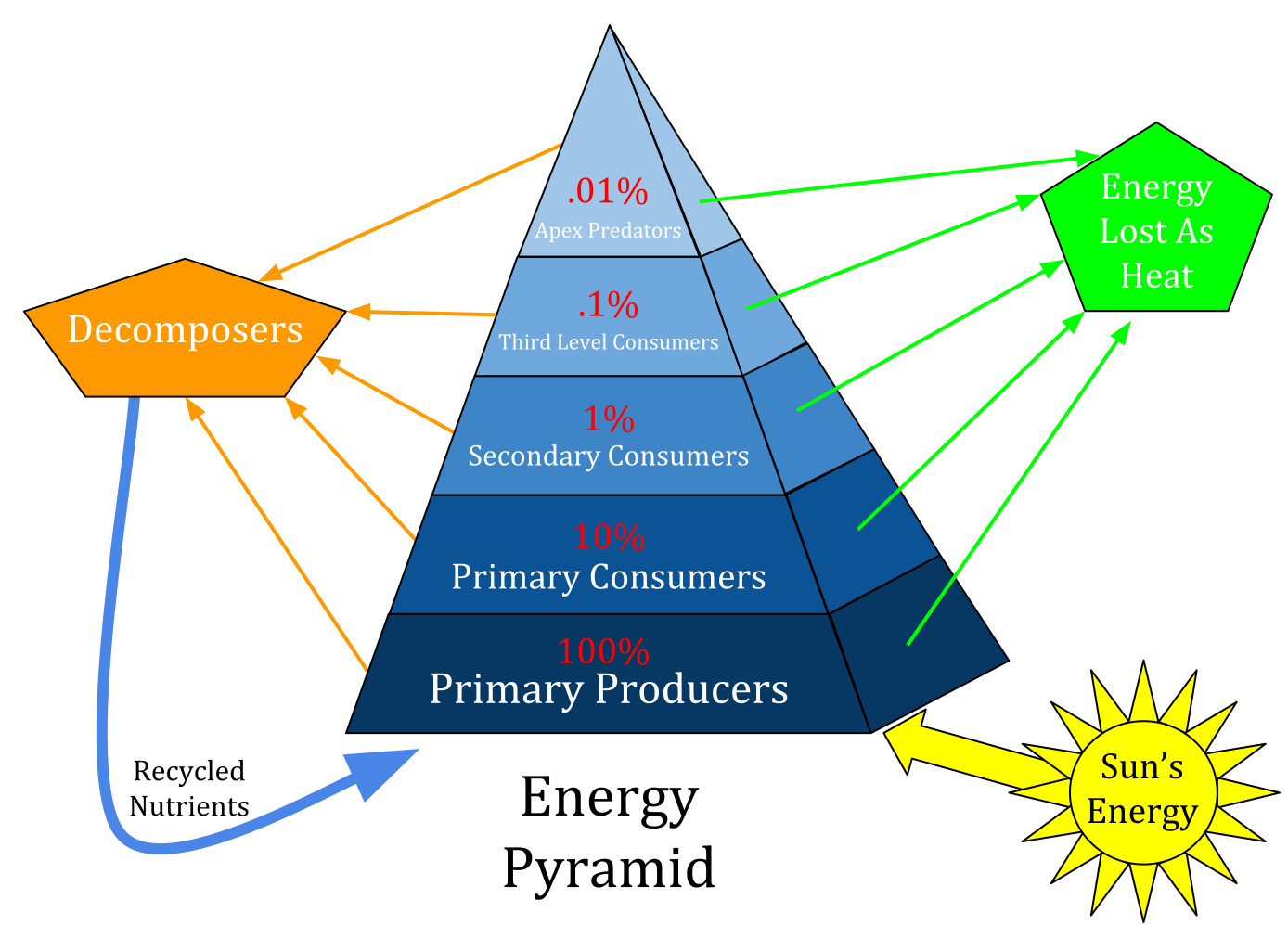
Energy does not cycle. At each step along a food chain, only a small part of the energy in the food is turned into the body mass of the consumer. Most is used for the consumer's own activities, such as movement and keeping warm, and is lost as heat, through respiration, or remains in wastes and uneaten parts. As a rule of thumb, about 10 percent of the energy at one trophic level is available to the next.
If producers fix 10,000 units of energy, about 1,000 are available to primary consumers, about 100 to secondary consumers and about 10 to tertiary consumers. This is why food chains rarely have more than four or five levels, and why there are many more plants than herbivores and many more herbivores than carnivores. It also explains why a top predator needs a large territory.
This pattern is the basis of an energy pyramid, which shows less energy at each higher level. Pyramids of biomass, the total mass of organisms, and of numbers can also be drawn, though these can sometimes be inverted. An example is a tree, a single producer, supporting thousands of insects.
Productivity
Gross primary productivity is the total amount of energy that producers capture by photosynthesis. Net primary productivity is what remains after producers use some of it for their own respiration, and it is the energy available to consumers. Net primary productivity equals gross primary productivity minus the energy used in respiration. Tropical rainforests and estuaries have very high productivity, and deserts and open oceans have low productivity per area.
Productivity is limited by light, temperature, water and nutrients. In many parts of the ocean, nitrogen or iron is the limiting nutrient, and adding it increases growth. This is why fertilizer runoff can cause algal blooms in lakes, and then the death and decay of the algae use up oxygen in the water, harming fish.
- Producers: capture energy from light or chemicals.
- Consumers: get energy by eating.
- Decomposers: recycle nutrients from dead matter.
- 10 percent rule: about a tenth of the energy passes to the next level.
- Net productivity: gross productivity minus the producers' respiration.
Energy flows, matter cycles
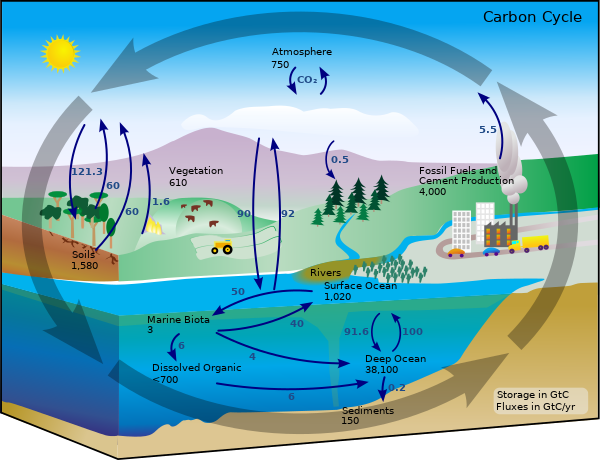
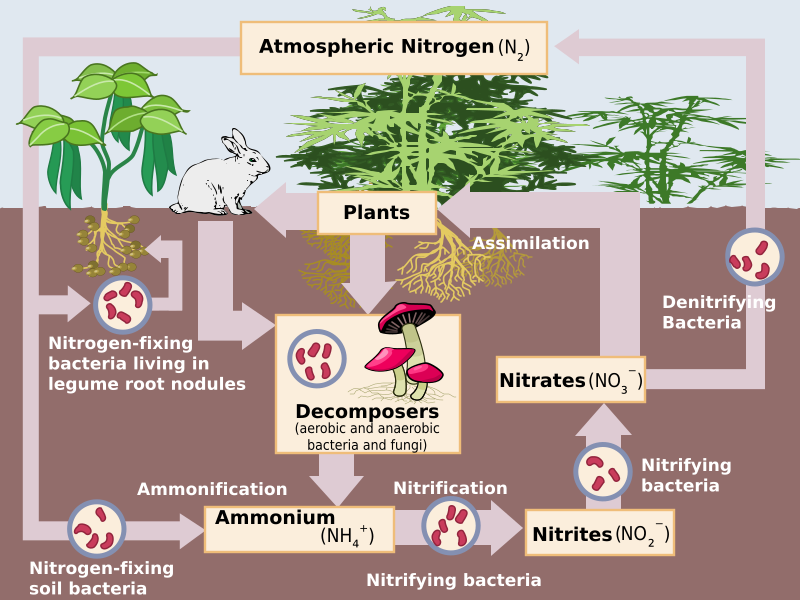
Energy moves in one direction through an ecosystem, entering as light and leaving as heat. Matter such as carbon, nitrogen and phosphorus is recycled. The same atoms are used again and again by different organisms, and decomposers return them to the producers. You will see this in the carbon and nitrogen cycles.
Worked example: a food web question
In a pond, algae are eaten by water fleas and by snails. Water fleas are eaten by small fish, and snails are eaten by small fish and by turtles. Small fish are eaten by herons. If the algae produce 50,000 kJ, the water fleas and snails together have about 5,000 kJ, the small fish and turtles about 500 kJ and the herons about 50 kJ, using the 10 percent rule.
Now remove the small fish. Water fleas and snails are eaten less, so they may increase and graze more algae, while herons lose a major food source and may eat more turtles or starve. A good answer traces the effect up and down the web and notes both a bottom-up and a top-down effect. Remember that the 10 percent rule is an average, and real transfers range from about 5 to 20 percent.
Why it matters for the exam
Questions give a food web or a table of energy values and ask you to calculate the energy at a level, identify the trophic level or predict the effect of removing a species. Show the 10 percent calculation clearly. If an organism is removed from a food web, trace which populations lose a food source and which lose a predator.
This topic continues from 3.3, where you learned about ATP and energy flow in cells, and prepares you for populations in 8.3 and 8.4 and communities in 8.5.
Key takeaways
- Producers capture energy, and consumers and decomposers use it.
- A food chain shows one path of energy, and a food web shows many.
- About 10 percent of the energy passes to the next trophic level.
- Energy pyramids get smaller at higher levels because of heat loss.
- Net primary productivity equals gross productivity minus respiration.
- Energy flows one way, and matter cycles.
- Decomposers return nutrients to producers.
How this shows up on the exam
- Multiple choice: identify trophic levels.
- Calculation: energy available at a trophic level.
- Short answer: explain why food chains are short.
- Reasoning skill: predict effects of removing a species.
Common mistakes
- Saying energy is recycled. It flows through and leaves as heat.
- Saying 90 percent of energy is passed on. About 10 percent is.
- Saying decomposers are not part of the food web. They are essential.
- Saying a pyramid of energy can be inverted. Energy always decreases upward.
Key terms
- ecosystem
- producer
- consumer
- decomposer
- chemosynthesis
- trophic level
- food chain
- food web
- energy pyramid
- 10 percent rule
- gross primary productivity
- net primary productivity
- limiting nutrient
Check yourself
Topic 8.2 quiz
Producers in an ecosystem capture 20,000 kJ of energy. About how much is available to secondary consumers using the 10 percent rule?