8.7 Disruptions to Ecosystems
Invasive species, pollution, habitat loss and climate change disrupt ecosystems. Human activity is now the biggest driver, but ecologists also see ways to reduce and repair the damage.
Natural and human disruptions
Ecosystems are always changing. Natural events such as fires, floods, storms, volcanic eruptions and droughts disturb them, and many communities recover through succession. Some ecosystems even depend on disturbance. Certain pine forests need periodic fires to open their cones and clear the ground. Recovery depends on the size and frequency of the disturbance and on the diversity of the community.
Human activities now alter ecosystems on a global scale and much faster than most natural events. The main threats are habitat loss, invasive species, pollution, overharvesting and climate change. A helpful memory aid for these threats is HIPPO: habitat loss, invasive species, pollution, population growth of humans and overharvesting.
Disruptions can move an ecosystem beyond its ability to recover, which can lead to extinctions. The current rate of extinction is far above the average rate seen in the fossil record.
Invasive species and habitat loss
An invasive species is a nonnative species that spreads and harms its new environment. In its new home, it often has no natural predators, parasites or diseases to keep it in check, and so it grows quickly, close to exponentially, as in 8.3. It may outcompete native species, eat them or bring diseases. Examples include kudzu in the southeastern United States, zebra mussels in the Great Lakes, Burmese pythons in the Everglades and cane toads in Australia.
Habitat loss is the leading cause of extinction. Clearing land for farms, cities and roads destroys habitat, and habitat fragmentation splits the remaining habitat into small patches. Small, isolated populations lose genetic diversity through drift and inbreeding, as explained in 7.4 and 7.11, and they cannot move to find food or mates. Wildlife corridors, which connect patches, can help.
Pollution and climate change
Pollution harms organisms directly and by changing the environment. Eutrophication occurs when fertilizer, sewage or detergent adds extra nitrogen and phosphorus to water, causing algae to grow rapidly. When the algae die, bacteria decompose them and use up the oxygen, which kills fish and other animals. Biomagnification is the increase in the concentration of a toxin at each trophic level, as it is not broken down or excreted. The pesticide DDT concentrated in fish-eating birds such as eagles and made their eggshells thin, and its ban helped populations recover.
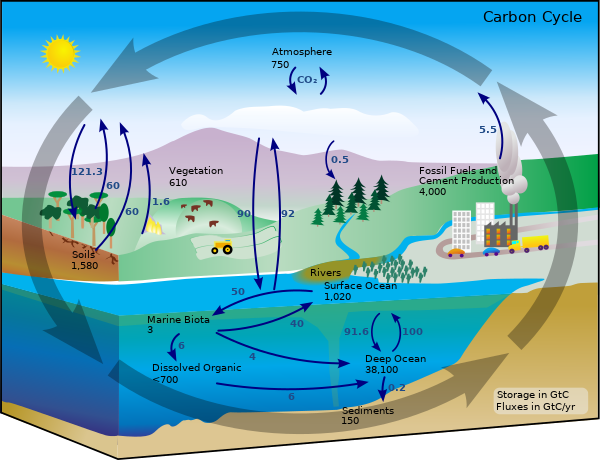
Climate change is a long-term change in the average temperature and weather patterns. Burning fossil fuels and clearing forests add carbon dioxide to the atmosphere, as in the carbon cycle. Carbon dioxide and other greenhouse gases trap heat, which raises the average temperature of the planet. Effects include melting ice, rising sea level, shifts in the ranges of species and changes in the timing of seasonal events. When carbon dioxide dissolves in seawater, it makes the ocean more acidic, which harms organisms that build shells, such as corals.
Species can respond to climate change by moving, adapting or dying out. Species that cannot move quickly, or that have little genetic variation or very narrow niches, are at the greatest risk. Coral bleaching, caused by warmer water, is one of the most visible effects.
What can be done
Conservation can reduce the damage. Protected areas, wildlife corridors, restoring habitats, controlling invasive species, reducing pollution and using resources sustainably all help. Reducing fossil fuel use slows climate change. Laws such as the Endangered Species Act in the United States have helped species such as the bald eagle recover. Preserving genetic diversity, through captive breeding and seed banks, gives species a better chance to adapt.
- Habitat loss and fragmentation: the leading cause of extinction.
- Invasive species: grow fast without natural enemies.
- Eutrophication: nutrient pollution leads to low oxygen.
- Biomagnification: toxins concentrate up the food chain.
- Climate change: greenhouse gases warm the planet and acidify oceans.
- Conservation: protect habitat, control invasives, cut emissions.
Worked example: tracing a human impact
A coastal town builds a large farm upstream from a bay. Fertilizer washes into the river and then into the bay, adding nitrogen and phosphorus. Algae bloom on the surface and block sunlight, so seagrass on the bottom dies. When the algae die, bacteria decompose them and use up the oxygen. Fish and crabs leave or die, creating a dead zone. The loss of seagrass removes nursery habitat for young fish, so the effects continue.
Solutions can be set out at several levels: farmers can use less fertilizer or plant buffer strips of vegetation along the river, towns can upgrade sewage treatment and the government can regulate runoff. When you are asked to propose and justify a solution, name the cause, say how your action breaks the chain of events and mention a limit or trade-off, such as the cost to farmers. That shows both science and critical thinking.
Why it matters for the exam
Questions give a scenario of a human activity and ask you to predict effects on an ecosystem, or to propose a solution. Use ideas from earlier topics: the food web, carrying capacity, density factors, diversity and the carbon cycle. In an eutrophication question, give the whole chain: more nutrients, algal bloom, decomposition, oxygen loss and death of fish.
This topic ends Unit 8 and the course. It connects ecology back to the molecules of Unit 1, such as the carbon in carbon dioxide, and to the evolution in Unit 7, since a changing environment is a new selection pressure.
Key takeaways
- Natural disturbances are followed by succession.
- Human threats include habitat loss, invasive species, pollution, overharvesting and climate change.
- Invasive species grow fast in new areas without natural enemies.
- Habitat fragmentation isolates populations and reduces genetic diversity.
- Eutrophication leads to algal blooms and low oxygen.
- Biomagnification concentrates toxins at higher trophic levels.
- Greenhouse gases cause warming, and carbon dioxide also acidifies oceans.
How this shows up on the exam
- Multiple choice: predict an effect of a disturbance.
- Short answer: explain eutrophication step by step.
- Data question: carbon dioxide and temperature over time.
- Reasoning skill: propose and justify a conservation action.
Common mistakes
- Saying all disturbances are harmful. Some ecosystems depend on them.
- Saying biomagnification lowers toxin levels higher in the food chain. Levels rise.
- Saying eutrophication adds oxygen. It lowers oxygen after the algae die.
- Saying invasive species are always found in their native range. They are nonnative.
Key terms
- disturbance
- invasive species
- habitat loss
- habitat fragmentation
- eutrophication
- biomagnification
- climate change
- greenhouse gas
- ocean acidification
- extinction
- conservation
- wildlife corridor
Check yourself
Topic 8.7 quiz
Fertilizer runoff enters a lake. What is the most likely sequence of effects?