4.2 Introduction to Signal Transduction
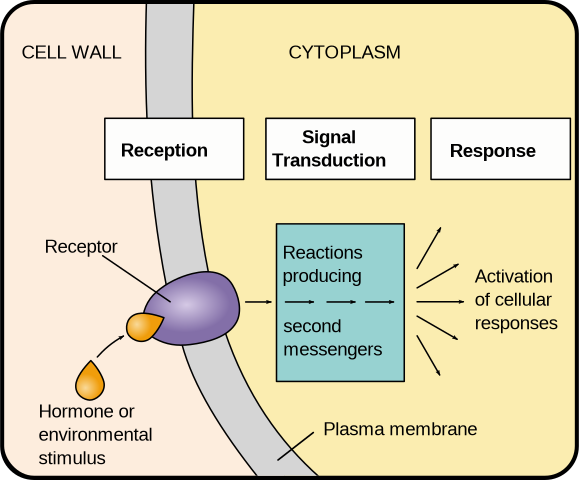
A signal starts a response when it binds a receptor. The receptor changes shape, which begins a chain of events that passes the message into the cell.
Reception: ligand meets receptor
Reception is the first step. The ligand binds to a specific region of the receptor protein, in the same way a substrate fits an enzyme's active site. This binding changes the shape of the receptor, which is the actual signal inside the cell. Because the fit is specific, a receptor responds only to its own ligand or to molecules shaped much like it.
This is why drugs can work. Some medicines are shaped like the natural ligand and activate the receptor. Others are shaped like the ligand but do not activate it, and they block the receptor so that the real signal cannot get in. These two types are called agonists and antagonists, and the second kind are similar to competitive inhibitors of enzymes.
A receptor can be present in very different numbers in different cells. A cell with many receptors for a ligand responds strongly, and a cell with few responds weakly.
Receptors in the plasma membrane
Most receptors for water-soluble ligands are in the plasma membrane, and they cross it. The outside part binds the ligand, and the inside part passes on the message. Two common types are G protein-coupled receptors, which work through a protein bound to GTP, and receptor tyrosine kinases, which are enzymes that add phosphate groups to proteins. Ligand-gated ion channels open a pore when the ligand binds.
In a G protein-coupled receptor, ligand binding causes the receptor to activate a G protein inside the cell. The G protein then activates an enzyme, which makes a second messenger. You do not need to know detailed examples, but you should know the general sequence. In a receptor tyrosine kinase, binding makes two receptor molecules join and add phosphates to each other, which activates them.
Receptors inside the cell
Steroid hormones such as estrogen, testosterone and cortisol are nonpolar, so they pass through the membrane and bind to receptors in the cytoplasm or nucleus. The hormone-receptor complex then acts as a transcription factor, which means it binds to DNA and turns specific genes on or off. The response is a change in gene expression, and this usually takes more time but lasts longer.
Thyroid hormones also act by entering the cell. Because the response involves making new proteins, the effect may take hours. In contrast, surface receptor responses such as the release of glucose or the opening of a channel can occur in seconds.
Signal transduction pathways
Signal transduction is the process of converting the signal into a response through a series of steps. The chain of events lets the cell amplify a small signal, add control points and make sure the message goes to the right place. Each step involves a protein that changes shape or a small molecule that moves, and the message is carried across the cell without the ligand itself ever entering.
A common method is phosphorylation, adding a phosphate group to a protein using ATP. A kinase adds the phosphate and a phosphatase removes it. The addition of a phosphate group changes the protein's shape and switches it on or off. Another method is the use of second messengers, small molecules like cyclic AMP and calcium ions, which spread quickly and activate many proteins. You will see details of these in 4.3.
- Ligand: the first messenger from outside.
- Receptor: detects the signal and changes shape.
- Relay proteins and second messengers: pass the message on.
- Kinases and phosphatases: add and remove phosphates as switches.
- Response: change in enzyme activity, gene expression or cell behavior.
Worked example: predicting the effect of a receptor change
Imagine a mutation in a receptor changes the shape of the ligand-binding site so that the hormone no longer fits. The hormone is present at normal levels, but the cell does not respond. The pathway inside the cell is fine, but it never starts. Compare this with a mutation that makes the receptor active even without a ligand, which would turn the pathway on all the time.
In both cases, the effect is traced from the receptor to the response. This is the exact way to write an answer: state what the mutation changes, how that affects binding or activation, what happens to the next step and what happens to the final response. Both cases have real examples, since some forms of cancer involve receptors stuck in the on position.
Why it matters for the exam
On the exam, a diagram may show a ligand, receptor and a pathway, and ask what would happen if one part were changed. A strong answer goes step by step: if the receptor shape changes, the ligand cannot bind, the pathway does not start and the response does not happen. Also remember the link between a ligand's polarity and the location of its receptor.
Mutations in receptors or pathway proteins are linked to diseases such as cancer, which you will see in 4.6. Many drugs target these pathways.
Key takeaways
- Reception begins when a ligand binds a specific receptor.
- Binding changes the receptor shape.
- Water-soluble ligands bind surface receptors such as G protein-coupled receptors.
- Nonpolar ligands bind receptors inside the cell and often change gene expression.
- Signal transduction relays and amplifies the message.
- Phosphorylation by kinases switches proteins on or off.
- Second messengers such as cAMP and calcium spread the signal.
How this shows up on the exam
- Multiple choice: match a ligand to its receptor location.
- Short answer: explain what happens when a receptor is mutated.
- Diagram question: identify the steps in a pathway.
- Reasoning skill: predict the effect of blocking a step.
Common mistakes
- Saying the ligand enters the cell in surface receptor pathways. It stays outside.
- Saying all receptors are on the membrane. Steroid receptors are inside.
- Saying phosphorylation removes phosphates. It adds them.
- Saying a mutated receptor has no effect. It can block or overactivate the pathway.
Key terms
- receptor
- G protein-coupled receptor
- receptor tyrosine kinase
- ligand-gated channel
- signal transduction
- second messenger
- cAMP
- kinase
- phosphatase
- phosphorylation
- transcription factor
- agonist
- antagonist
Check yourself
Topic 4.2 quiz
Which ligand is most likely to bind a receptor inside the cell?