4.3 Signal Transduction
Inside the cell, a signal passes through a chain of molecules. Phosphorylation cascades and second messengers amplify the message so that a small signal makes a large response.
Cascades and amplification
A cascade is a chain in which each molecule activates the next. At each step one activated molecule can activate many molecules of the next type, so the signal gets bigger. A single ligand binding to one receptor can eventually lead to thousands of molecules responding. This amplification is the reason tiny amounts of hormones can have powerful effects.
Think of a chain of dominoes in which each one knocks over ten. After four steps, a single push has toppled ten thousand. Cells use the same logic. It also gives the cell several places to regulate the response, because each step can be sped up, slowed or stopped.
A cascade also lets cells coordinate. A signal at the surface can end up changing enzymes in the cytoplasm and genes in the nucleus at the same time.
Phosphorylation cascades
In many pathways, the relay is a series of protein kinases. Each kinase, when activated, adds a phosphate group from ATP to the next kinase, which changes its shape and activates it. That kinase then activates the next one. At the end of the chain, a final protein is phosphorylated, and that protein carries out the response, such as turning on a gene.
Phosphatases are enzymes that remove the phosphate groups, which switches the proteins off again. This lets the cell end a signal quickly. The balance between kinases and phosphatases controls whether the pathway is active. Because phosphorylation is reversible, it works like a light switch that the cell can flip at will.
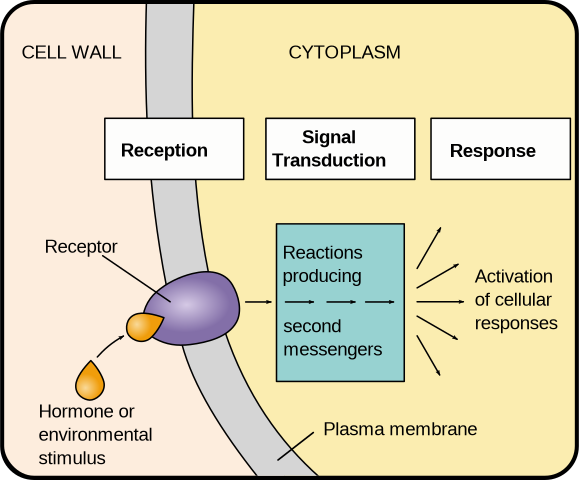
Second messengers
A second messenger is a small molecule that carries the signal inside the cell after the receptor receives the first message. Cyclic AMP, or cAMP, is made from ATP by the enzyme adenylyl cyclase when a G protein is activated. It spreads through the cytoplasm and activates protein kinases. Calcium ions are another second messenger, released from storage in the endoplasmic reticulum, and they activate many proteins.
Second messengers are small and move quickly, so the signal spreads fast. They are also removed quickly, which allows the signal to be switched off. An enzyme called phosphodiesterase breaks down cAMP. Caffeine works partly by blocking this enzyme, so cAMP levels stay higher for longer.
Because one receptor can activate many enzymes that each make many second messengers, this is also a strong form of amplification.
Cell responses and what can go wrong
The response may be a change in enzyme activity, such as the breakdown of glycogen into glucose after adrenaline binds a liver cell. It may be a change in gene expression, such as the production of a new protein. It may also be a change in cell behavior, such as movement, division or even programmed cell death, called apoptosis.
Errors in pathways cause disease. A pathway stuck in the on position can cause uncontrolled cell division, as in many cancers. Cholera toxin locks a G protein in the active state, which keeps the pathway on and makes intestinal cells release large amounts of water and ions. Diabetes involves poor response of cells to insulin. These cases show why correct signaling matters.
- Cascade: a chain of activations that amplifies the signal.
- Kinase: adds a phosphate to turn a protein on or off.
- Phosphatase: removes a phosphate.
- Second messenger: cAMP or calcium that spreads the signal.
- Apoptosis: programmed cell death, one possible response.
Worked example: amplification by numbers
Suppose one receptor activates 10 G proteins, each G protein activates one enzyme, and each enzyme makes 100 molecules of cAMP. Starting with a single ligand binding one receptor, the cell ends up with 10 times 100, or 1,000 molecules of cAMP. If each cAMP molecule activates one kinase, and each kinase phosphorylates 50 target proteins, then 50,000 proteins are changed from one initial signal. This is the power of amplification.
Now picture a drug that blocks the enzyme that breaks down cAMP. Every cAMP molecule would last longer and the signal would be stronger and last longer. A drug that blocks the kinase would do the opposite. These examples show why cascades are useful targets for medicine, and how you can predict the effect of changing one step.
Why it matters for the exam
Typical questions give a pathway and a change, such as a drug that blocks a kinase or a mutation that makes a receptor always active, and ask for the effect on the cell. Follow the steps one by one. Also remember that amplification explains how a small signal gets a large response.
This topic builds the base for feedback in 4.4 and for control of cell division in 4.5 and 4.6, where signaling pathways decide when a cell divides.
Key takeaways
- A signal transduction pathway relays a message from receptor to response.
- Cascades amplify a small signal into a large response.
- Protein kinases add phosphate groups that switch proteins on or off.
- Phosphatases remove phosphates and turn the signal off.
- Second messengers such as cAMP and calcium spread the signal quickly.
- Responses include changes in enzymes, genes and cell behavior.
- Errors in pathways can cause diseases such as cancer.
How this shows up on the exam
- Multiple choice: identify what a kinase does.
- Short answer: explain how a signal is amplified.
- Data question: compare response with and without an inhibitor.
- Reasoning skill: predict the effect of a mutation in one step.
Common mistakes
- Saying a second messenger is the original ligand. It is made inside the cell.
- Saying phosphatases add phosphates. They remove them.
- Saying one ligand makes one product. Cascades amplify the signal.
- Saying a pathway always needs gene changes. Many responses are changes in enzyme activity.
Key terms
- signal transduction
- cascade
- amplification
- protein kinase
- phosphatase
- second messenger
- cAMP
- adenylyl cyclase
- calcium ion
- apoptosis
- G protein
- response
Check yourself
Topic 4.3 quiz
A mutation locks a kinase in the active state. What is the most likely result?