4.5 The Cell Cycle
The cell cycle is the series of events by which a cell grows and divides. Interphase prepares the cell, and mitosis splits the copied chromosomes into two identical nuclei.
Why cells divide
Cells divide for three main reasons. Organisms grow by making more cells, damaged or worn-out tissues are replaced, and single-celled organisms and some others reproduce this way. As you saw in 2.2, a cell that grows too large has a poor surface area to volume ratio, so division also keeps cells at a workable size. Each new cell must receive a complete copy of the DNA, so the cell has to copy its DNA first and then split it evenly.
Eukaryotic DNA is organized into chromosomes, which are long DNA molecules wrapped around proteins called histones. After copying, each chromosome consists of two identical sister chromatids joined at a region called the centromere. When the cell divides, the sister chromatids separate, and each new cell gets one copy of each chromosome.
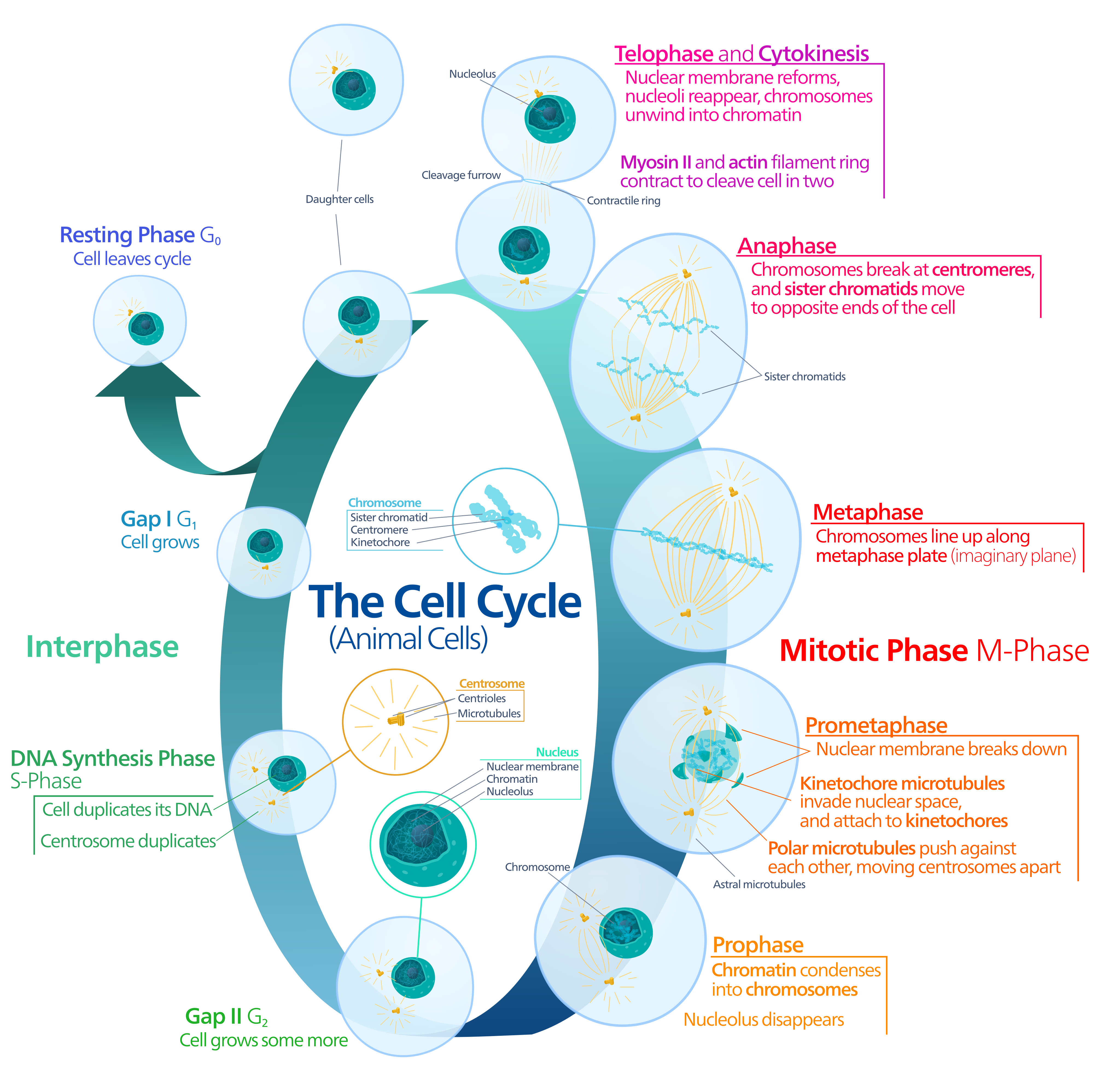
Interphase: getting ready
Most of a cell's life is spent in interphase, which has three parts. In G1, the first gap phase, the cell grows and carries out its normal functions. In the S phase, the cell copies its DNA, so each chromosome gets a sister chromatid. In G2, the second gap phase, the cell grows more, makes proteins needed for division and checks the copied DNA for errors.
Some cells stop dividing and leave the cycle in a resting state called G0. Many nerve cells and muscle cells stay in G0 for life, and others, such as liver cells, can return to the cycle when needed. Interphase is not a resting stage in the usual sense. The cell is very active, and the DNA copying happens here.
Mitosis: dividing the nucleus
Mitosis has four main phases. In prophase, the chromosomes coil and become visible, the nuclear envelope breaks down and the spindle fibers begin to form from the centrosomes. In metaphase, the chromosomes line up along the center of the cell, called the metaphase plate, with spindle fibers attached to the centromeres. In anaphase, the sister chromatids are pulled apart toward opposite poles, and each is now a separate chromosome. In telophase, the chromosomes reach the poles and uncoil, new nuclear envelopes form and the spindle breaks down.
A simple memory aid for the order is PMAT. Metaphase is the lineup, anaphase is the apart stage, and telophase is the two new nuclei. The result of mitosis is two nuclei with the same number and type of chromosomes as the original, so daughter cells are genetically identical to the parent cell and to each other.
Cytokinesis and the difference between cells
Cytokinesis is the splitting of the cytoplasm, and it usually starts during late anaphase or telophase. In animal cells, a ring of protein fibers pinches the cell in two, forming a cleavage furrow. In plant cells, there is a rigid wall, so vesicles carrying cell wall material gather at the center and form a cell plate, which grows outward into a new wall dividing the two cells.
Prokaryotes do not go through mitosis. They divide by binary fission, in which the circular chromosome is copied and the cell splits in two. The cell cycle gives a time-based picture, and you should be able to identify each stage from a drawing or a graph of DNA amount over time. The DNA content doubles during S phase and halves after the cell divides.
Worked example: reading phase data
A biologist counts 200 cells in an onion root tip and finds 160 in interphase, 20 in prophase, 6 in metaphase, 4 in anaphase and 10 in telophase. To estimate how long each phase lasts in a 24-hour cell cycle, multiply the fraction of cells in each phase by 24 hours. Interphase is 160 out of 200, or 80 percent, so about 19.2 hours. Prophase is 10 percent, or 2.4 hours. Metaphase is 3 percent, or 0.7 hours, anaphase is 2 percent, or 0.5 hours and telophase is 5 percent, or 1.2 hours.
The logic is that if a phase takes longer, more cells will be caught in it at any moment. The result that most cells are in interphase fits with the fact that interphase includes growth and DNA copying. When reading such a table, always state the assumption that the sample represents a population of cells that are dividing at random.
Why it matters for the exam
You will be asked to identify the stage from a micrograph, to count chromosomes or DNA amounts at each stage, and to explain why mitosis gives identical cells. A common data question shows the percent of cells in each phase and asks which phase is longest. Interphase is almost always the answer, because most cells are not dividing at any moment.
Mitosis produces the identical cells used in growth and repair. In Unit 5, you will compare it with meiosis, which produces different cells for reproduction. Understanding the stages here will prevent confusion there.
Key takeaways
- The cell cycle includes interphase, mitosis and cytokinesis.
- Interphase has G1, S and G2, and DNA is copied in S.
- Chromosomes are made of two sister chromatids joined at a centromere after S phase.
- Mitosis goes through prophase, metaphase, anaphase and telophase.
- Mitosis makes two genetically identical nuclei.
- Cytokinesis uses a cleavage furrow in animals and a cell plate in plants.
- Prokaryotes divide by binary fission.
How this shows up on the exam
- Multiple choice: identify a stage from a description.
- Data question: percent of cells in each phase.
- Short answer: explain why daughter cells are identical.
- Reasoning skill: track DNA amount through the cycle.
Common mistakes
- Saying DNA is copied in prophase. It is copied in S phase.
- Saying interphase is a resting phase. The cell is active and copying DNA.
- Saying sister chromatids separate in metaphase. They separate in anaphase.
- Saying plant cells pinch in two. They build a cell plate.
Key terms
- cell cycle
- interphase
- G1
- S phase
- G2
- G0
- mitosis
- prophase
- metaphase
- anaphase
- telophase
- cytokinesis
- chromosome
- sister chromatid
- centromere
- spindle fiber
- cleavage furrow
- cell plate
- binary fission
Check yourself
Topic 4.5 quiz
In which phase of the cell cycle is DNA copied?