5.1 Meiosis
Meiosis is a two-step division that turns one diploid cell into four haploid cells. It produces gametes, and it halves the chromosome number so that fertilization restores it.
Why meiosis exists
Sexual reproduction combines DNA from two parents. If each parent gave a full set of chromosomes, the number would double with every generation. Meiosis solves this by making sex cells, or gametes, with half the usual number of chromosomes. When a sperm and an egg fuse in fertilization, the full number is restored. In humans, body cells have 46 chromosomes and gametes have 23.
A cell with two sets of chromosomes, one from each parent, is diploid, written 2n. A cell with one set is haploid, written n. The two chromosomes of the same type, one from each parent, are homologous chromosomes. They carry the same genes in the same order, but they may have different versions, called alleles, of those genes. Meiosis separates the homologs so each gamete gets only one of each pair.
Meiosis happens only in special cells in the reproductive organs. Body cells use mitosis, which makes identical cells for growth and repair, so the two processes have different jobs.
Meiosis I: separating homologous pairs
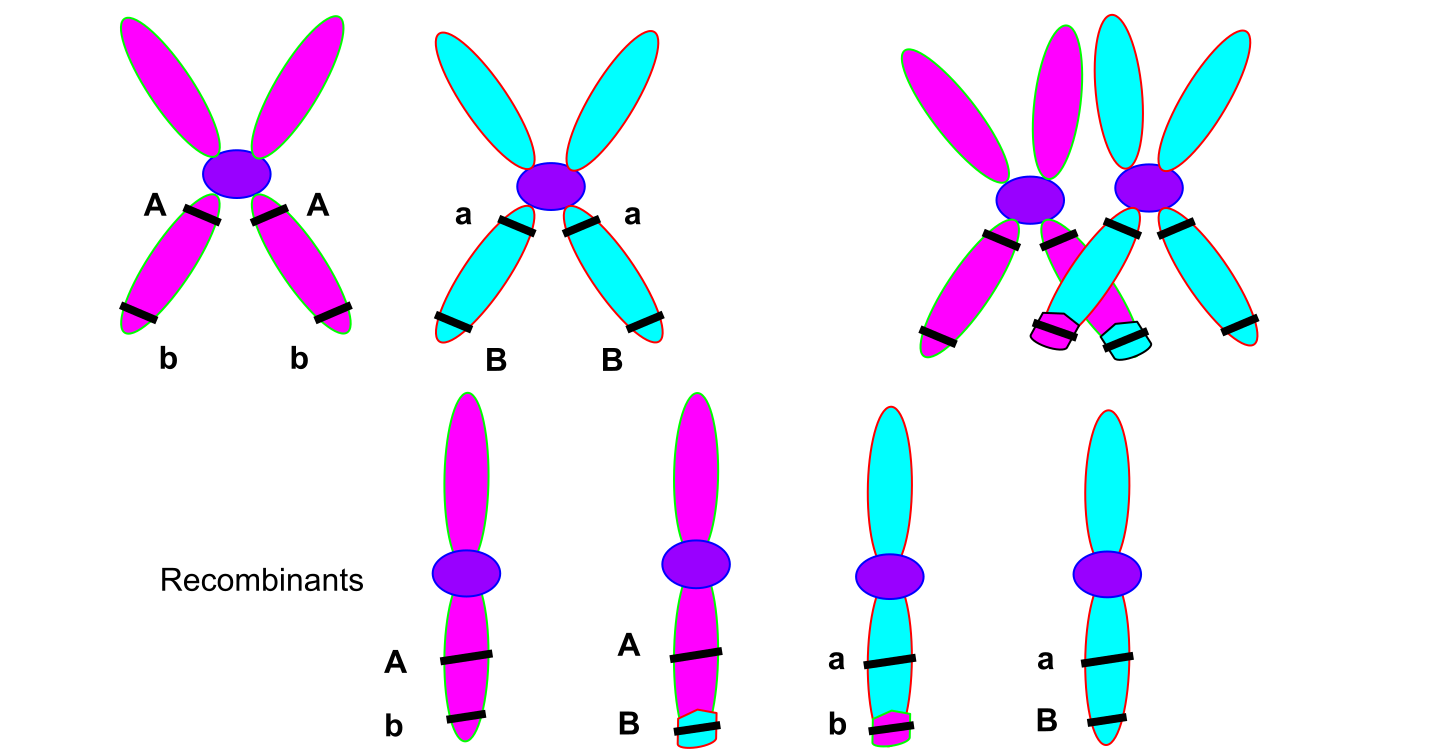
Before meiosis starts, the DNA is copied once in the S phase, so each chromosome has two sister chromatids. Then the cell divides twice. In prophase I, homologous chromosomes pair up closely in a process called synapsis, and they swap pieces in crossing over. In metaphase I, the homologous pairs line up in the middle, side by side. In anaphase I, the homologs are pulled apart, but the sister chromatids stay together. In telophase I and cytokinesis, two cells form.
The important point is that meiosis I is the reduction division. It is the step that halves the chromosome number, because each new cell receives only one chromosome from each homologous pair. The cells are now haploid, even though each chromosome still has two chromatids. The sister chromatids are not separated until the next step.
Meiosis II: separating sister chromatids
Meiosis II is similar to mitosis. There is no more DNA copying between the two divisions. In prophase II, the chromosomes condense again in each of the two cells. In metaphase II, the chromosomes line up in the middle singly, not in pairs. In anaphase II, the sister chromatids separate. In telophase II and cytokinesis, each cell divides, giving four cells in total.
The result is four haploid cells, each with a single set of chromosomes, each made of one chromatid. In males, all four become sperm. In females, the divisions are uneven, and in humans generally only one cell becomes a mature egg, while the others are small cells that break down. The gametes are genetically different from each other and from the original cell.
Meiosis compared with mitosis
A frequent mistake on the exam is mixing up when the chromosome number is halved. It is halved in meiosis I, when homologous chromosomes separate. In meiosis II, the number of chromosomes stays the same, but the sister chromatids separate, so each chromosome now has one chromatid.
Errors in meiosis can occur. Nondisjunction is the failure of chromosomes to separate properly, and it can give gametes with an extra or a missing chromosome. If such a gamete is fertilized, the result may be a condition such as Down syndrome, in which a person has three copies of chromosome 21.
Worked example: counting chromosomes and chromatids
A diploid cell has 4 chromosomes, 2 from each parent. After S phase, there are still 4 chromosomes, but each has 2 chromatids, so there are 8 chromatids. At metaphase I, there are 2 homologous pairs at the middle. After meiosis I, each of the two cells has 2 chromosomes with 2 chromatids each, so the cell is haploid, but each chromosome is still doubled. After meiosis II, each of the four cells has 2 chromosomes with 1 chromatid each.
DNA content follows the same pattern. If the starting cell has 4 units of DNA in G1, then it has 8 after S phase, 4 in each cell after meiosis I and 2 in each cell after meiosis II. Drawing a small table of cells, chromosomes, chromatids and DNA at each stage prevents the common error of mixing up when the number halves.
Why it matters for the exam
Questions show a diagram of a cell and ask which stage it is, or ask for the number of chromosomes or chromatids at a stage. Count carefully: look for paired homologs in meiosis I and single chromosomes at the metaphase plate in meiosis II. You may also be asked to explain why gametes are genetically different.
Meiosis connects to everything in Unit 5. The next topic explains how it creates variation, and the rest of the unit explains how traits are passed to offspring.
Key takeaways
- Meiosis makes four haploid cells from one diploid cell.
- DNA is copied once, and the cell divides twice.
- Homologous chromosomes separate in meiosis I.
- Sister chromatids separate in meiosis II.
- Crossing over occurs in prophase I.
- Meiosis I is the reduction division.
- Nondisjunction can lead to the wrong number of chromosomes.
How this shows up on the exam
- Multiple choice: identify the stage from a drawing.
- Short answer: compare mitosis and meiosis.
- Data question: chromosome counts at each stage.
- Reasoning skill: explain the effect of nondisjunction.
Common mistakes
- Saying sister chromatids separate in meiosis I. Homologs separate then.
- Saying meiosis makes identical cells. The cells are different.
- Saying DNA is copied before each division in meiosis. It is copied once.
- Saying meiosis II halves the chromosome number. It was already halved in meiosis I.
Key terms
- meiosis
- gamete
- diploid
- haploid
- homologous chromosomes
- synapsis
- crossing over
- reduction division
- sister chromatids
- fertilization
- nondisjunction
- allele
Check yourself
Topic 5.1 quiz
At the end of meiosis I, how do the cells compare with the original cell?