5.2 Meiosis and Genetic Diversity
Crossing over, independent assortment and random fertilization all shuffle genes. Together they make sure that offspring differ from their parents and from each other.
Why variation matters
Offspring from sexual reproduction are not identical to either parent. This variation is useful. A population with many different traits is more likely to have some individuals that survive a disease, a drought or a new predator. In Unit 7, you will see that variation is the raw material for evolution. Meiosis and fertilization are the main sources of new combinations of existing alleles in a population.
Three processes create the variation. Two take place in meiosis and one in fertilization. Each one works on a different level, and their effects multiply. Because they happen every time gametes are made, no two gametes from the same person are likely to be the same.
It is important to separate new combinations from new alleles. Meiosis shuffles the alleles that already exist. New alleles come from mutation, which you will study in Unit 6.
Crossing over
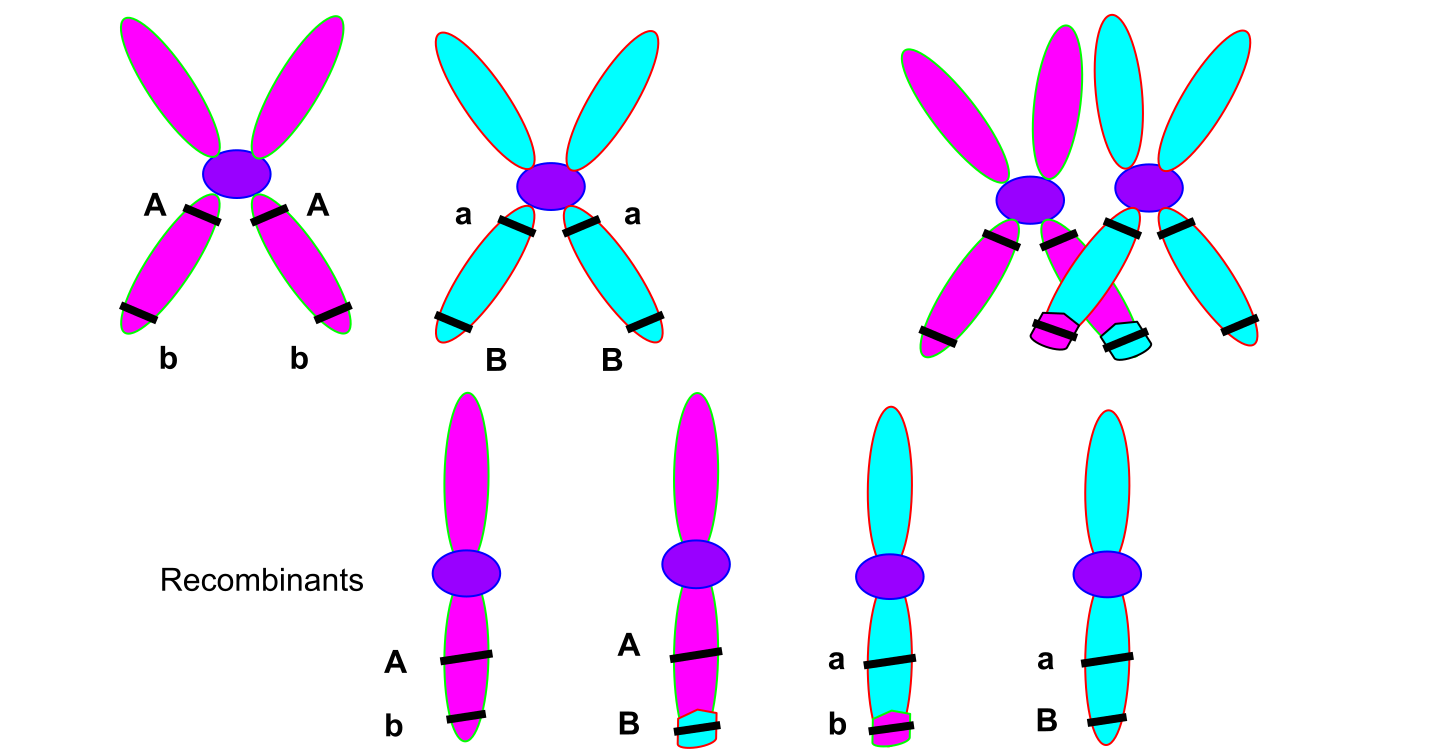
In prophase I, homologous chromosomes pair tightly, and segments of non-sister chromatids are exchanged. This is crossing over. The points of exchange are called chiasmata. The result is that each chromosome becomes a mix of maternal and paternal DNA, called a recombinant chromosome. The alleles are now in new combinations on the same chromosome.
Before crossing over, a chromosome from your mother carries one set of alleles along its length. After crossing over, the chromatid might have your mother's alleles for part of its length and your father's alleles for the rest. Crossing over occurs at several places along each pair. It does not change the amount of DNA or the genes present, only the way the alleles are combined.
Independent assortment
In metaphase I, the homologous pairs line up at the middle of the cell. The orientation of each pair is random, and it does not depend on how other pairs line up. This random orientation is called independent assortment. Each gamete gets a random mix of maternal and paternal chromosomes.
The number of possible combinations is 2 raised to the power of n, where n is the number of chromosome pairs. For humans with 23 pairs, there are over 8 million possible combinations from independent assortment alone, and this does not include crossing over. In a species with only 3 pairs, there would be only 8 combinations.
Independent assortment also explains why genes on different chromosomes are inherited independently, which is the basis of Mendel's second law in topic 5.3.
Random fertilization
Which sperm fertilizes which egg is a matter of chance. Each human egg is one of millions of possible combinations, and so is each sperm. The number of different zygotes that one couple could produce is over 70 trillion, which is 8 million times 8 million, even before counting crossing over. This is why siblings, other than identical twins, look similar but are not the same.
Identical twins form when one fertilized egg splits in two, so they share the same DNA. Fraternal twins come from two separate eggs and two sperm, and they are as different as ordinary siblings.
- Crossing over: new combinations of alleles on one chromosome, in prophase I.
- Independent assortment: random orientation of pairs, in metaphase I.
- Random fertilization: chance combination of two gametes.
- Mutation: the source of brand new alleles, not part of meiosis itself.
Worked example: counting possible gametes and zygotes
A fruit fly has 4 pairs of chromosomes. Independent assortment alone allows 2 to the fourth power, or 16, different combinations of maternal and paternal chromosomes in its gametes. Two flies can therefore produce 16 times 16, or 256, combinations of zygotes, before counting crossing over. With crossing over, each chromosome can be a mosaic, so the actual number is far larger.
Humans have 23 pairs, so 2 to the 23rd is about 8.4 million gamete types per person, and about 70 trillion zygote combinations per couple. This explains why it is so unlikely that two siblings, other than identical twins, will have the same genotype. In an exam answer, state the formula, show the substitution and then explain what this means for variation.
Why it matters for the exam
You may be asked to name the source of variation in a description, such as the swapping of segments between homologs. State the process, the stage and the effect. You may also be asked to calculate the number of possible gametes using 2 to the power of n. Show the formula and the number of pairs.
The idea of variation connects meiosis with Mendel's laws in 5.3, with linked genes in 5.4 and with natural selection in Unit 7.
Key takeaways
- Meiosis and fertilization create genetic variation.
- Crossing over swaps segments between homologous chromosomes in prophase I.
- Independent assortment randomizes how pairs line up in metaphase I.
- The number of gamete combinations is 2 to the power of n.
- Random fertilization adds further variation.
- Mutation is the only source of new alleles.
- Variation helps populations survive changes.
How this shows up on the exam
- Multiple choice: name the source of variation.
- Calculation: possible gametes from n pairs.
- Short answer: explain why siblings differ.
- Reasoning skill: link variation to survival.
Common mistakes
- Saying crossing over happens in meiosis II. It happens in prophase I.
- Saying meiosis creates new alleles. Mutation does.
- Saying independent assortment happens between sister chromatids. It involves homologous pairs.
- Saying siblings are identical. Only identical twins share DNA.
Key terms
- genetic variation
- crossing over
- chiasma
- recombinant chromosome
- independent assortment
- random fertilization
- mutation
- allele
- zygote
- identical twins
Check yourself
Topic 5.2 quiz
An organism has 4 pairs of chromosomes. How many gamete combinations are possible from independent assortment alone?