5.3 Mendelian Genetics
Mendel showed that traits are passed on by separate units, now called genes. Punnett squares, testcrosses and the chi-square test let you predict and check inheritance.
Mendel and his peas
Gregor Mendel was a monk who studied inheritance in garden pea plants in the 1850s and 1860s. He chose peas because they grow fast, produce many offspring and have clear either-or traits, such as purple or white flowers and round or wrinkled seeds. He started with true-breeding plants, which always produce the same trait when self-pollinated, and crossed them to see what happened.
When he crossed a purple-flowered plant with a white-flowered plant, all the offspring, called the F1 generation, had purple flowers. When the F1 plants were crossed with each other, about three-quarters of the F2 offspring had purple flowers and one-quarter had white. The white trait had not vanished. It had been hidden, and it came back in the next generation. This pointed to separate units of inheritance.
We now call these units genes, and the different versions of a gene are alleles. Mendel did not know about DNA, but his idea turned out to be correct.
Key terms and Mendel's laws
An organism has two alleles for each gene, one from each parent. If the alleles are the same, the organism is homozygous, and if different, it is heterozygous. A dominant allele shows in the phenotype when at least one copy is present, and a recessive allele shows only when two copies are present. The genotype is the combination of alleles, such as Pp, and the phenotype is the visible trait, such as purple flowers.
The law of segregation says that the two alleles for a gene separate during gamete formation, so each gamete gets only one. This matches what happens to homologous chromosomes in meiosis I. The law of independent assortment says that alleles of different genes are sorted into gametes independently, so the inheritance of one trait does not affect another. This is true for genes on different chromosomes, as in metaphase I.
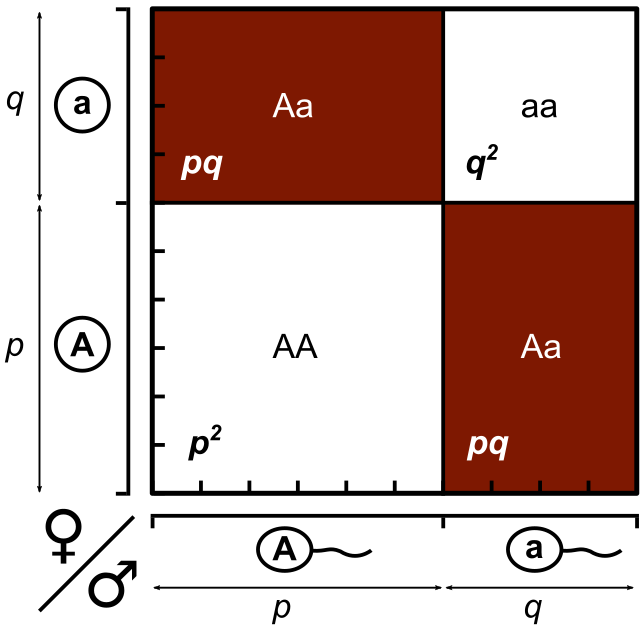
The ratios that Mendel found follow from these laws. A cross of two heterozygotes gives a 3 to 1 ratio of dominant to recessive phenotypes and a 1 to 2 to 1 ratio of genotypes. A cross of two heterozygotes for two genes gives a 9 to 3 to 3 to 1 ratio.
Using Punnett squares and testcrosses
A Punnett square is a grid that shows the possible gametes from each parent along the sides and the resulting offspring inside. To use one, write the alleles each parent can pass on, fill in the boxes by combining one allele from each side and count the results. For a cross of Pp and Pp, the offspring are PP, Pp, Pp and pp, giving three purple to one white.
A testcross is used to find the genotype of an organism showing the dominant phenotype. It could be homozygous dominant or heterozygous. The organism is crossed with a homozygous recessive one. If all offspring show the dominant trait, the unknown parent is probably homozygous dominant. If about half show the recessive trait, the unknown parent is heterozygous.
For probabilities, use two rules. The rule of multiplication applies to independent events that must both happen, such as the chance of getting heads twice. The rule of addition applies when there are different ways to get an outcome, and you add the chances together. These rules let you work out two-gene crosses without a big grid.
The chi-square test
Real data seldom match predictions exactly, so scientists use the chi-square test to decide whether a difference is due to chance. The formula is chi-square equals the sum of (observed minus expected) squared divided by expected, calculated for each category. The formula is given on the exam reference sheet.
To use it, calculate the expected number for each phenotype from the predicted ratio, find chi-square, and compare it to a critical value. The degrees of freedom equal the number of categories minus one. With p equal to 0.05, the critical value for 1 degree of freedom is 3.84, and for 3 degrees of freedom it is 7.81. If your value is lower than the critical value, you do not reject the null hypothesis, meaning the difference could be from chance. If it is higher, you reject the null hypothesis.
For example, if a cross is expected to give 75 purple and 25 white out of 100, and you observe 70 purple and 30 white, then chi-square equals 25 over 75 plus 25 over 25, which is about 1.33. This is less than 3.84, so the difference is probably due to chance and the data fit the 3 to 1 ratio.
Worked example: a dihybrid cross
In pea plants, round seeds (R) are dominant to wrinkled (r), and yellow seeds (Y) are dominant to green (y). Cross two plants that are heterozygous for both traits, RrYy. Each parent makes four types of gamete in equal numbers: RY, Ry, rY and ry. A 4 by 4 Punnett square gives 16 boxes. The phenotypes appear in the ratio 9 round yellow, 3 round green, 3 wrinkled yellow and 1 wrinkled green.
A faster way is to use the multiplication rule. The chance of round is three-quarters and of yellow is three-quarters, so the chance of round and yellow is 9 over 16. The chance of wrinkled and green is one-quarter times one-quarter, or 1 over 16. If a cross gives results far from 9 to 3 to 3 to 1, test it with chi-square. Four categories means 3 degrees of freedom, and the critical value at p equal to 0.05 is 7.81.
Why it matters for the exam
Genetics problems are some of the most common on the exam. Write the parent genotypes, the gametes and the offspring, and state your ratio or probability clearly. Use the correct terms for genotype and phenotype. For the chi-square, show the table of observed, expected and the calculation.
This topic is the basis for Unit 5. The next topic covers inheritance that does not follow simple Mendelian patterns, and later units connect genes to DNA and to evolution.
Key takeaways
- Mendel found that traits are passed on in separate units, now called genes.
- Dominant alleles show when one copy is present, and recessive alleles need two copies.
- Genotype is the allele combination, and phenotype is the trait seen.
- Segregation separates alleles into gametes, and independent assortment sorts genes separately.
- A cross of two heterozygotes gives a 3:1 phenotype ratio.
- A testcross uses a homozygous recessive to find an unknown genotype.
- Chi-square tests whether data fit expected ratios, with degrees of freedom equal to categories minus one.
How this shows up on the exam
- Multiple choice: predict offspring ratios.
- Calculation: chi-square for a cross.
- Short answer: explain a testcross.
- Reasoning skill: use probability rules for two genes.
Common mistakes
- Saying a recessive trait disappears. It can return in a later generation.
- Saying dominant means more common. It means it shows when present.
- Saying degrees of freedom equal the number of categories. It is categories minus one.
- Saying a chi-square below the critical value proves the hypothesis. It means you fail to reject the null.
Key terms
- gene
- allele
- dominant
- recessive
- homozygous
- heterozygous
- genotype
- phenotype
- law of segregation
- law of independent assortment
- Punnett square
- testcross
- true-breeding
- chi-square
- degrees of freedom
- null hypothesis
Check yourself
Topic 5.3 quiz
Two heterozygous purple-flowered plants (Pp) are crossed. What fraction of offspring are expected to have white flowers?