1.1 Structure of Water and Hydrogen Bonding
Water is polar, so its molecules stick to each other and to other polar substances through hydrogen bonds. That one fact explains why water is a good solvent, why it resists temperature change and why life depends on it.
Warm-up: the chemistry you need first
Welcome to AP Biology. Unit 1 starts with chemistry, and that surprises many people. The reason is simple: a cell is a bag of chemicals, so understanding life begins with understanding how atoms stick together. You do not need to have taken a chemistry class. This section gives you the four ideas you need, in plain words, before the main topic.
Atoms and charge. Everything is made of atoms. An atom has a center with positive protons and uncharged neutrons, and negative electrons moving around it. Living things are built mostly from six kinds of atoms: carbon, hydrogen, oxygen, nitrogen, phosphorus and sulfur. Atoms like to have a full outer set of electrons, so they share or trade electrons with other atoms. That sharing is what holds them together.
Bonds. When two atoms share electrons, they form a covalent bond, which is strong and holds molecules like water together. When one atom takes an electron from another, the two become charged ions that attract each other, called an ionic bond. Sometimes the sharing is not fair. One atom pulls the shared electrons closer, so it gets a slight negative charge and the other end gets a slight positive charge. That uneven sharing is called a polar bond.
Polar and nonpolar. A molecule with charged ends is polar, and one with even sharing is nonpolar. The rule you will use all year is that like dissolves like. Polar things mix with water, and nonpolar things such as oil do not. This one rule explains why cell membranes form, why some vitamins dissolve in fat, and why proteins fold the way they do.
Weak attractions. Slight charges on different molecules attract each other. These attractions are called hydrogen bonds when they involve hydrogen on one molecule and oxygen or nitrogen on another. One hydrogen bond is weak, but millions together are strong, which is how water holds together and how DNA strands stay paired. Keep this idea in mind: strong bonds build molecules, and many weak bonds shape them.
If these ideas feel new, that is fine. Read the main section slowly and come back here whenever a word is unclear. Almost everything in Units 2 to 8 uses these four ideas again, so the time you spend here pays off all year.
A polar molecule with a bent shape
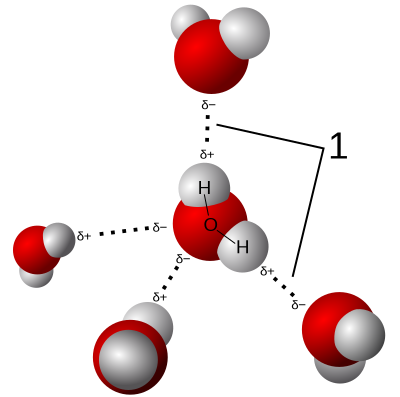
A water molecule has one oxygen atom bonded to two hydrogen atoms. Oxygen pulls the shared electrons closer to itself because it is more electronegative than hydrogen. This unequal sharing makes the bonds polar covalent. The molecule is also bent, not straight, so the partial negative charge sits on the oxygen end and the partial positive charge sits on the hydrogen end. A molecule with two charged ends is called a dipole.
Because of this charge pattern, the oxygen of one water molecule is attracted to a hydrogen of a neighbor. That attraction is a hydrogen bond. A single hydrogen bond is weak, but each water molecule can form up to four of them, and billions form at once. The bonds constantly break and re-form, which is why liquid water can flow while still holding together.
Cohesion, adhesion and surface tension
Cohesion is the attraction between molecules of the same substance. Water molecules cohere because of hydrogen bonds, which lets plants pull a continuous column of water from roots to leaves. As water evaporates from a leaf, the molecules behind it are pulled along, much like a chain being pulled from one end. This is how tall trees move water upward without a pump.
Adhesion is the attraction between water and a different substance, such as the polar cellulose walls of xylem cells. Adhesion keeps water from sliding back down and helps it climb narrow tubes. Together, cohesion and adhesion explain capillary action. Cohesion also creates surface tension, the tight film at the surface of water. A water strider can walk on a pond because the surface molecules are bonded more strongly to each other than to the air above.
Temperature, ice and solvent properties
Water has a high specific heat, meaning it takes a lot of energy to raise its temperature by one degree. Much of the heat goes into breaking hydrogen bonds before the molecules can move faster. Because cells and oceans are mostly water, temperatures change slowly, which protects living things from sudden swings. Water also has a high heat of vaporization, so evaporation, such as sweating, removes a large amount of heat from the body.
Ice is less dense than liquid water. As water freezes, hydrogen bonds lock the molecules into a spacious lattice, so they sit farther apart than in the liquid. Ice therefore floats and forms an insulating layer on top of lakes, leaving liquid water below for aquatic life. Water is also the universal solvent of life because its charged ends surround and separate ions and polar molecules. Substances that dissolve in water are hydrophilic, while nonpolar substances such as oils are hydrophobic.
Key properties at a glance
- Cohesion: water sticks to water through hydrogen bonds, which moves water up plant stems and creates surface tension.
- Adhesion: water sticks to other polar surfaces, helping it climb narrow tubes.
- High specific heat: water absorbs a lot of heat with little temperature change, which stabilizes cells, bodies and climates.
- Ice floats: the open lattice of frozen water is less dense than liquid water, so lakes freeze from the top down.
- Solvent ability: polar water dissolves ions and polar molecules, so it carries nutrients and wastes.
Water in living systems
The properties of water show up in every unit. Inside a cell, water is the medium where most reactions happen, because enzymes and their substrates dissolve in it. In blood and plant sap, water carries dissolved sugars, ions and wastes from one place to another. In the cell membrane, water's polarity pushes nonpolar fatty acid tails together, which is the reason a phospholipid bilayer forms on its own.
Water also takes part directly in reactions. In photosynthesis, water is split to supply electrons, and in hydrolysis it is added to break polymers. Because pure water also separates a tiny number of molecules into H+ and OH- ions, it sets the starting point for the pH scale. Solutions with more H+ than OH- are acidic, and solutions with fewer are basic. Cells use buffers to keep their pH steady because enzymes work only within narrow pH ranges.
Temperature matters just as much. Because water absorbs heat slowly, an organism that is mostly water can survive a hot afternoon without its enzymes overheating. Large bodies of water also moderate the climate of nearby land, which affects which organisms can live there and ties this topic to ecology in Unit 8.
Why it matters for the exam
Questions on this topic rarely ask you to define a word. They ask you to apply it. A common task is to explain a plant, an animal or an organism adaptation using one property, for example why a lake does not freeze solid or why a leaf can still pull water up on a hot day. Name the property, then name the hydrogen bonding behind it. That second step is what earns the point.
This topic also sets up later units. Hydrophobic and hydrophilic behavior shapes the cell membrane in Unit 2, enzyme shape and protein folding in Units 1 and 3, and water movement in plants in Unit 8. If you understand why water is polar, much of the later chemistry becomes easier to reason through.
Key takeaways
- Water is polar because oxygen pulls shared electrons closer than hydrogen does.
- Hydrogen bonds form between the partial positive hydrogen of one molecule and the partial negative oxygen of another.
- Cohesion and adhesion together explain how water moves up plants.
- High specific heat comes from the energy needed to break many hydrogen bonds.
- Ice floats because hydrogen bonds hold molecules in an open lattice.
- Water dissolves polar and ionic substances, so it is the solvent of the cell.
- Always connect a property of water back to hydrogen bonding in an answer.
How this shows up on the exam
- Multiple choice: a description of a lake in winter or a plant on a hot day, asking which property explains it.
- Short answer: explain how cohesion and adhesion help water reach the top of a tree.
- Data question: a graph of temperature change for water and another liquid, asking which has the higher specific heat.
- Reasoning skill: justify a claim about an adaptation using the structure of water.
Common mistakes
- Saying hydrogen bonds are bonds inside a water molecule. The bonds inside are covalent. Hydrogen bonds are the weak attractions between separate molecules.
- Saying water is polar because it is a liquid. Water is polar because of its bent shape and unequal electron sharing.
- Confusing cohesion with adhesion. Cohesion is water to water. Adhesion is water to a different surface.
- Saying ice floats because it is colder. It floats because it is less dense, since its hydrogen bonds fix the molecules farther apart.
Key terms
- polar covalent bond
- dipole
- electronegativity
- hydrogen bond
- cohesion
- adhesion
- surface tension
- capillary action
- specific heat
- heat of vaporization
- hydrophilic
- hydrophobic
- solvent
- lattice
Check yourself
Topic 1.1 quiz
Which statement best explains why a water strider can walk on the surface of a pond?