1.7 Structure and Function of Biological Macromolecules: Proteins
Proteins are chains of amino acids that fold into precise shapes. Their shape decides their job, so changing the sequence or the environment can change what a protein does.
Amino acids: the building blocks
A protein is a polymer of amino acids. Every amino acid has the same core: a central carbon bonded to an amino group, a carboxyl group, a hydrogen and a side chain called the R group. The core is identical in all twenty amino acids. The R group is what differs, and it can be nonpolar, polar, positively charged or negatively charged. Because of this, the sequence of R groups gives each protein its own chemical personality.
Amino acids join by peptide bonds. A peptide bond forms when the carboxyl group of one amino acid reacts with the amino group of the next, and a water molecule is released, which makes it dehydration synthesis. A chain of amino acids is called a polypeptide. The chain has an amino end, called the N-terminus, and a carboxyl end, called the C-terminus, which gives it direction just like a strand of DNA.
The order of amino acids is written into DNA, as you will see in Unit 6. A cell can make an almost endless range of proteins from only twenty building blocks, in the same way that twenty-six letters make every word in a language. The order of the letters, not just which ones are used, carries the meaning.
Four levels of protein structure
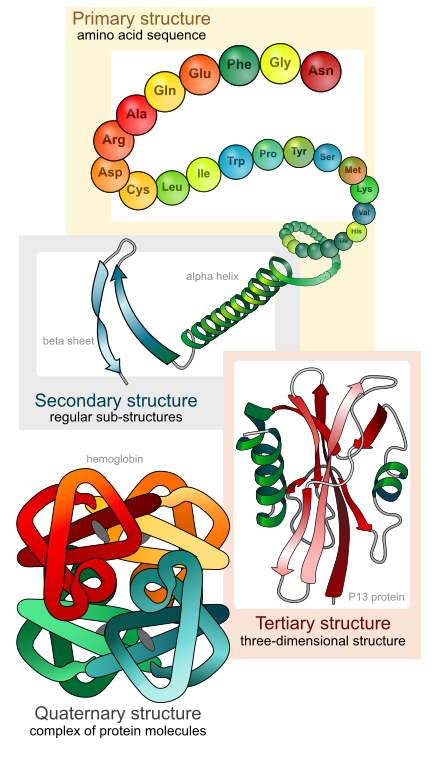
Primary structure is the sequence of amino acids in the chain. It is held together by peptide bonds and it decides everything that follows. Secondary structure is local folding into alpha helices and beta pleated sheets, held by hydrogen bonds between atoms in the backbone. These bonds are between the backbone atoms, not the R groups, so they form in many different proteins in similar ways.
Tertiary structure is the overall three-dimensional shape of one polypeptide. It forms because R groups interact with each other and with water. Nonpolar R groups cluster in the interior to avoid water, polar R groups sit on the outside, and oppositely charged R groups form ionic bonds. Two cysteine R groups can form a strong covalent disulfide bridge. Together these interactions fold the chain into a compact shape.
Quaternary structure appears only in proteins made of two or more polypeptides that join together. Hemoglobin is a classic example, with four polypeptide chains that work as one unit. Many proteins have no quaternary structure, because they consist of a single chain. Be careful on the exam, since not every protein has all four levels.
Shape decides function
A protein works because of its shape. An enzyme has an active site that fits one substrate, a receptor has a pocket that fits one signal molecule, and a channel has a pore that fits one ion. If the shape changes, the protein may stop working. This relationship between structure and function is one of the biggest ideas in biology, and it shows up in nearly every unit.
The shape in turn depends on the sequence. Changing even one amino acid can change how a chain folds. In sickle cell disease, one glutamic acid in hemoglobin is replaced by valine, which is nonpolar. That small change makes hemoglobin molecules stick to each other in low oxygen and bend red blood cells into a sickle shape. A single change in the primary structure led to a large change in function.
Cells use this idea on purpose. Some proteins change shape when a molecule binds or when a phosphate group is added, and this acts like a switch. You will meet these switches when we study enzymes, membranes and cell signaling.
When shape is lost: denaturation
Denaturation is the loss of a protein's three-dimensional shape without breaking its peptide bonds. Heat, a change in pH, or certain chemicals disrupt the weak bonds and interactions that hold the secondary and tertiary structures, so the protein unfolds. The sequence stays the same, but the function is usually lost. Cooking an egg turns the clear white solid because the proteins unfold and tangle together.
This is why enzymes have an ideal temperature and pH, and why a high fever is dangerous. In some cases, a denatured protein can refold if the conditions return to normal, but often it cannot. When asked what changes in denaturation, say that the tertiary structure and secondary structure are lost, while the primary structure stays the same.
- Primary: the sequence, held by peptide bonds.
- Secondary: helices and sheets, held by hydrogen bonds in the backbone.
- Tertiary: the full folded shape of one chain, held by R group interactions.
- Quaternary: several chains together, only in some proteins.
- Denaturation: the loss of the secondary, tertiary and quaternary structure, but not the primary structure.
Why it matters for the exam
Protein questions usually give a change, such as a new amino acid, a higher temperature or a different pH, and ask what happens to the shape and function. Follow a chain of steps: the change affects the bonds between R groups, which changes the folding, which changes the active site or binding site, which changes the function. Writing the chain of steps earns the reasoning points.
This topic ties the whole unit together. Proteins are made by joining monomers through dehydration synthesis, they get their shape from the same polar and nonpolar rules you saw in water and lipids, and they are the molecules that do most of the work in the cells you study in Unit 2.
Key takeaways
- Proteins are polymers of twenty kinds of amino acids joined by peptide bonds.
- The R group makes each amino acid different and drives folding.
- Primary structure is the sequence. Secondary is helices and sheets. Tertiary is the full fold. Quaternary is multiple chains.
- A protein's shape decides its function.
- A single amino acid change can alter the shape, as in sickle cell disease.
- Denaturation destroys the shape but does not break peptide bonds.
- Heat, pH and chemicals can denature a protein.
How this shows up on the exam
- Multiple choice: identify the level of structure affected by a change.
- Short answer: explain how one amino acid change can alter a protein.
- Data question: enzyme activity at different temperatures or pH.
- Reasoning skill: link structure to function in a new example.
Common mistakes
- Saying denaturation breaks peptide bonds. It does not, and the sequence stays the same.
- Saying hydrogen bonds hold the tertiary structure only. Several R group interactions are involved.
- Saying every protein has quaternary structure. Only multi-chain proteins do.
- Saying the sequence of amino acids is the secondary structure. That is the primary structure.
Key terms
- amino acid
- R group
- peptide bond
- polypeptide
- primary structure
- secondary structure
- alpha helix
- beta pleated sheet
- tertiary structure
- disulfide bridge
- quaternary structure
- denaturation
- active site
- N-terminus
- C-terminus
Check yourself
Topic 1.7 quiz
A protein is heated until it loses its function. Which level of structure is still intact?