1.5 Lipids
Lipids are nonpolar molecules that store energy, build membranes and act as signals. Their behavior in water comes directly from their long hydrocarbon chains.
What makes a molecule a lipid
Lipids are a group of molecules that share one trait: they are mostly nonpolar and therefore do not dissolve well in water. They are made mainly of carbon and hydrogen, with only a little oxygen. This is why oil and water separate into layers. Lipids are not true polymers because they are not long chains of one repeating monomer, but several important lipids are built from smaller parts joined by dehydration synthesis.
Because they are nonpolar, lipids can form barriers. A cell membrane keeps water-based fluid inside from mixing with the water-based fluid outside, and it can do that because its core is made of lipid. Lipids also carry out jobs beyond membranes, including long-term energy storage, insulation, cushioning of organs and signaling through steroid hormones.
Fats: glycerol and fatty acids
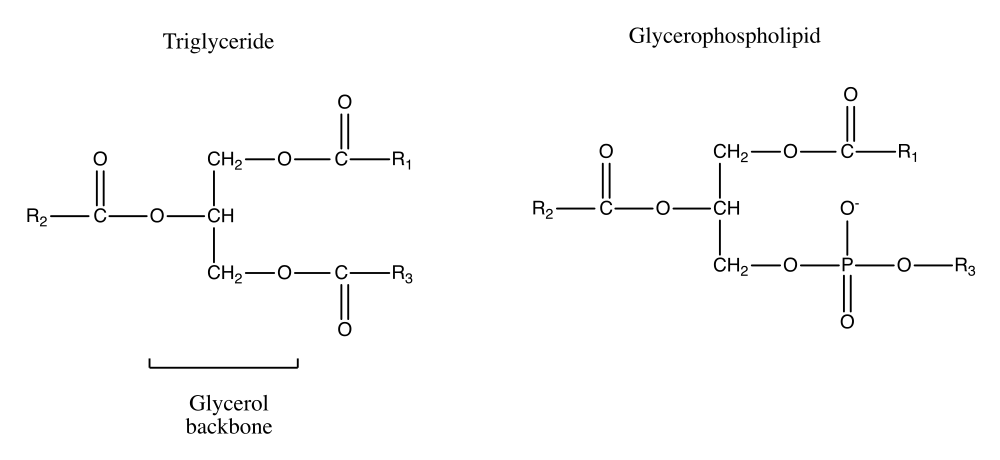
A fat, or triglyceride, is made of one glycerol molecule joined to three fatty acids by ester linkages. Each linkage forms when a hydroxyl group on glycerol reacts with the carboxyl group of a fatty acid, releasing water. A fatty acid is a long hydrocarbon chain with a carboxyl group at one end. The long chain is nonpolar, which makes the whole molecule hydrophobic.
Fats store energy very efficiently. The many carbon-hydrogen bonds in the chains release a lot of energy when broken, and because fats are hydrophobic they are stored without attracting water. This is why animals store energy as fat for months while carbohydrate stores such as glycogen last only hours. Fat under the skin also insulates, and fat around organs protects them from shock.
Fatty acids can be saturated or unsaturated. Saturated fatty acids contain only single bonds between carbons, so the chain is straight and the molecules pack tightly, which usually makes the fat solid at room temperature. Unsaturated fatty acids contain one or more double bonds that put kinks in the chain, which keeps molecules apart and makes the fat liquid. Plant oils are generally unsaturated, and animal fats such as butter are generally saturated.
Phospholipids and the cell membrane
A phospholipid has a glycerol backbone, two fatty acid tails and a phosphate group in place of the third fatty acid. The phosphate group carries a charge, so the head is polar and hydrophilic, while the two tails are nonpolar and hydrophobic. A molecule with both a water-loving part and a water-fearing part is called amphipathic.
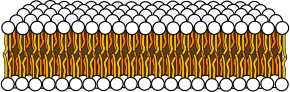
When phospholipids are placed in water, they arrange themselves so that the heads face the water and the tails face each other, away from water. This forms a phospholipid bilayer, and it happens on its own because it is the lowest-energy arrangement. The bilayer is the basic structure of every cell membrane. Its hydrophobic middle blocks the free passage of ions and large polar molecules, which gives the cell control over what comes in and out.
Steroids and other lipids
Steroids have a different shape from fats and phospholipids. They are built from four fused carbon rings with no fatty acid chains. Cholesterol is a steroid found in animal cell membranes, where it helps keep the membrane fluid at both warm and cool temperatures. Hormones such as estrogen and testosterone are also steroids that are made from cholesterol.
Waxes coat the leaves of plants to prevent water loss, and some lipids act as pigments or vitamins. The varied roles of lipids show that a group defined by being nonpolar can still have very different shapes and jobs. Always match the shape, such as a chain, a head-and-tail molecule or a set of rings, to the job it does.
Comparing the main lipids
- Fats (triglycerides): glycerol plus three fatty acids, used for long-term energy storage and insulation.
- Phospholipids: glycerol, two fatty acids and a phosphate head, forming the bilayer of membranes.
- Steroids: four fused rings, such as cholesterol and sex hormones.
- Waxes: long chains that waterproof surfaces such as leaves.
- Saturated: no double bonds, straight chains, usually solid.
- Unsaturated: double bonds create kinks, usually liquid.
Worked example: predicting behavior in water
Suppose you are given three molecules: a fatty acid with a long hydrocarbon tail and a carboxyl group, a triglyceride and a phospholipid. Ask of each one: how much of it is nonpolar, and does any part carry a charge? The triglyceride has three long tails and no charged part, so it clumps into droplets with no particular orientation. The phospholipid has a charged head, so it lines up at the surface of the water with its head in and its tails out, or it forms a bilayer when there is enough of it. A free fatty acid sits in between, since its carboxyl group is slightly polar.
This kind of reasoning also explains everyday observations. Salad dressing separates because oil is nonpolar and vinegar is mostly water. Soap works because soap molecules are amphipathic: the tails dissolve in grease while the heads face the water and carry the grease away. When you see a lipid question, start with the polar and nonpolar parts and the rest of the answer usually follows.
Why it matters for the exam
Lipid questions usually test the link between structure and behavior in water. You may see a diagram of a phospholipid and be asked to place the hydrophobic and hydrophilic regions, or to predict how the molecules would arrange in water. The answer is always a bilayer or a similar structure that hides the tails from water.
You may also see an experiment about membrane fluidity, where temperature or cholesterol content changes. Link the result to the packing of the fatty acid tails. Unit 2 builds directly on this topic when we study how substances cross the membrane, so a clear picture of the bilayer will be useful there.
Key takeaways
- Lipids are mostly nonpolar and do not dissolve well in water.
- A fat is glycerol joined to three fatty acids by ester linkages.
- Saturated fatty acids are straight and solid. Unsaturated ones are kinked and liquid.
- Phospholipids are amphipathic, with a hydrophilic head and two hydrophobic tails.
- Phospholipids form a bilayer in water because it hides the tails.
- Cholesterol and other steroids are made of four fused rings, not fatty acid chains.
- Fats store more energy per gram than carbohydrates.
How this shows up on the exam
- Multiple choice: a phospholipid diagram, asking which part faces water.
- Short answer: explain why phospholipids form a bilayer in water.
- Data question: membrane fluidity at different temperatures or cholesterol levels.
- Reasoning skill: relate saturation of fatty acids to the state of a fat.
Common mistakes
- Saying the phospholipid head is hydrophobic. The phosphate head is polar and hydrophilic.
- Saying unsaturated fats have no double bonds. Saturated fats have none.
- Saying cholesterol is a fat made of fatty acids. It is a steroid with four rings.
- Saying lipids are polymers. They are grouped by being nonpolar, not by a repeating monomer.
Key terms
- lipid
- nonpolar
- fat
- triglyceride
- glycerol
- fatty acid
- ester linkage
- saturated
- unsaturated
- phospholipid
- amphipathic
- hydrophilic
- hydrophobic
- phospholipid bilayer
- steroid
- cholesterol
Check yourself
Topic 1.5 quiz
When phospholipids are added to water, they spontaneously form a bilayer. What best explains this?