1.6 Nucleic Acids
DNA and RNA are polymers of nucleotides that store and carry genetic information. Their sequence of bases is the code, and their structure makes the code stable and copyable.
The nucleotide and the polynucleotide
A nucleotide has three parts: a five-carbon sugar, a phosphate group and a nitrogen-containing base. In DNA the sugar is deoxyribose, and in RNA it is ribose. The bases are adenine (A), guanine (G), cytosine (C), thymine (T) in DNA, and uracil (U) in place of thymine in RNA. A and G are larger two-ring bases called purines. C, T and U are smaller one-ring bases called pyrimidines.
Nucleotides join into a strand through phosphodiester bonds. Each bond links the phosphate on one nucleotide to the sugar of the next one, and it forms by dehydration synthesis. The result is a sugar-phosphate backbone with bases sticking out to the side. New nucleotides are always added at the 3' end, so the strand has a 5' end with a free phosphate and a 3' end with a free hydroxyl group.
Because the backbone repeats and the bases vary, the information is in the sequence of bases. A strand reading ATGC is a different message from one reading TGCA. Reading the sequence in one direction is a core skill for Unit 6, where a sequence of bases is turned into a sequence of amino acids.
DNA: a double helix of two antiparallel strands
DNA is a double helix, two strands wound around each other. The sugar-phosphate backbones are on the outside and the bases point inward. Bases from opposite strands pair by hydrogen bonds: A pairs with T through two bonds, and G pairs with C through three. Each pair always contains one purine and one pyrimidine, which keeps the width of the helix constant.
The two strands run in opposite directions, with one strand running 5' to 3' and the other 3' to 5'. This is called antiparallel. The pairing rule means that one strand predicts the other, so if you know one sequence you can write its complement. This is how a cell copies DNA, and it is why mutations in one strand can usually be detected and repaired by using the other strand as a template.
RNA: a flexible working copy
RNA differs from DNA in three ways. It contains ribose instead of deoxyribose, it uses uracil instead of thymine, and it is usually single-stranded. Being single-stranded lets RNA fold into shapes, which is how transfer RNA and ribosomal RNA do their jobs. The single strand is also easy to make and break down, so RNA is suited to short-lived messages.
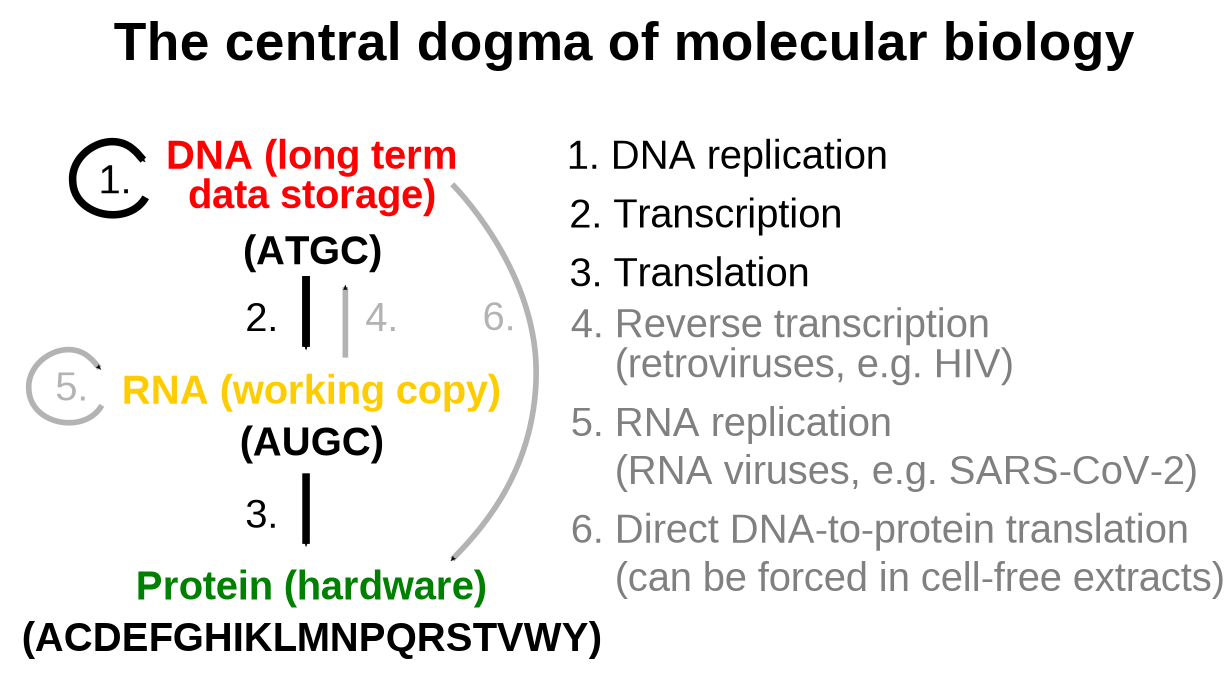
There are three main types in the cell. Messenger RNA (mRNA) carries the code from DNA to the ribosome. Transfer RNA (tRNA) brings amino acids to the ribosome. Ribosomal RNA (rRNA) is part of the ribosome and helps join amino acids. DNA acts as the permanent library and RNA acts as the working copy, which protects the master code from damage.
DNA compared with RNA
- Sugar: deoxyribose in DNA, ribose in RNA.
- Bases: A, T, G, C in DNA, and A, U, G, C in RNA.
- Strands: DNA is double-stranded, and RNA is usually single-stranded.
- Job: DNA stores genetic information long term, and RNA carries and uses it.
- Bond between strands: hydrogen bonds between bases, while the backbone uses phosphodiester bonds.
Using base pairing in problems
Many questions give a short DNA sequence and ask for the complementary strand or the mRNA made from it. For the complementary DNA strand, pair A with T and G with C. For mRNA, pair A with U, T with A, G with C and C with G. Always check the direction. If the template reads 3' TACGGA 5', the complementary strand reads 5' ATGCCT 3'.
Other questions give the percentage of one base and ask for the others. In double-stranded DNA, the amount of A equals the amount of T, and the amount of G equals the amount of C. If 30 percent of the bases are adenine, then 30 percent are thymine, and the remaining 40 percent are split equally between guanine and cytosine, giving 20 percent each. This does not apply to single-stranded RNA, so read the type of nucleic acid first.
Worked example: copying and reading a sequence
Take a short stretch of DNA written 5' ATGGCATTC 3'. To find the complementary strand, pair each base and reverse the direction: the partner strand reads 3' TACCGTAAG 5', which is written 5' GAATGCCAT 3' in the standard direction. If this first strand is the template for transcription, the mRNA is the complement with uracil: 5' GAAUGCCAU 3'. If instead the second strand is the template, the mRNA matches the first strand with U for T: 5' AUGGCAUUC 3'.
Always say which strand is the template before you answer, because the two choices give different RNA. A good habit is to write both ends on every strand. Many mistakes on the exam come from writing the right bases in the wrong direction, and labeling the ends takes only a few seconds.
Why it matters for the exam
Nucleic acid questions test whether you can use pairing rules and direction without mixing up DNA and RNA. A frequent mistake is using thymine in RNA or ignoring the 5' and 3' ends. Practice writing the complement slowly, labeling both ends.
This topic also supports Unit 5 on inheritance and Unit 6 on gene expression. Replication, transcription and translation all depend on base pairing and on the direction of synthesis, so mastering them now makes those units much easier.
Key takeaways
- A nucleotide has a sugar, a phosphate and a nitrogen-containing base.
- Nucleotides are joined by phosphodiester bonds, and new ones are added at the 3' end.
- DNA pairs A with T (two hydrogen bonds) and G with C (three hydrogen bonds).
- DNA strands are antiparallel and wound into a double helix.
- RNA has ribose and uracil and is usually single-stranded.
- mRNA, tRNA and rRNA each have a different job in making protein.
- In double-stranded DNA, A equals T and G equals C.
How this shows up on the exam
- Multiple choice: write the complementary or mRNA sequence from a DNA template.
- Short answer: compare DNA and RNA in structure and function.
- Data question: base percentages for DNA samples, asking for the missing values.
- Reasoning skill: explain how base pairing allows accurate copying.
Common mistakes
- Saying RNA contains thymine. RNA contains uracil.
- Saying A pairs with G. A pairs with T (or U in RNA), and G pairs with C.
- Saying the two DNA strands run in the same direction. They are antiparallel.
- Saying the base percentages rule applies to RNA. It applies only to double-stranded DNA.
Key terms
- nucleotide
- deoxyribose
- ribose
- purine
- pyrimidine
- phosphodiester bond
- 5' end
- 3' end
- double helix
- antiparallel
- complementary base pairing
- mRNA
- tRNA
- rRNA
- uracil
- sugar-phosphate backbone
Check yourself
Topic 1.6 quiz
A sample of double-stranded DNA is 24 percent thymine. What percent of the bases are cytosine?