2.1 Cell Structure and Function
Cells are the basic units of life. Each part of a cell does a specific job, and the two big types of cell, prokaryotic and eukaryotic, are organized differently.
Every cell has the same basic parts
All cells share four features. They are surrounded by a plasma membrane, they contain cytoplasm, they carry genetic material in DNA, and they have ribosomes for making proteins. These shared features are one reason scientists think all life has a common ancestor. A cell is not a random bag. It is a organized set of parts that work together to take in matter and energy, make molecules and respond to the surroundings.
The plasma membrane is the boundary. It controls what enters and leaves, which keeps the inside different from the outside. The cytoplasm is the fluid and everything suspended in it, and it is where many reactions happen. Ribosomes are not surrounded by a membrane, and they build proteins by reading the instructions copied from DNA. Without ribosomes, a cell could not make the enzymes it needs to live.
These basic parts are the starting point, and then cells add more. The extra parts differ between the two cell types, and the difference is one of the most important divisions in biology.
Prokaryotes and eukaryotes
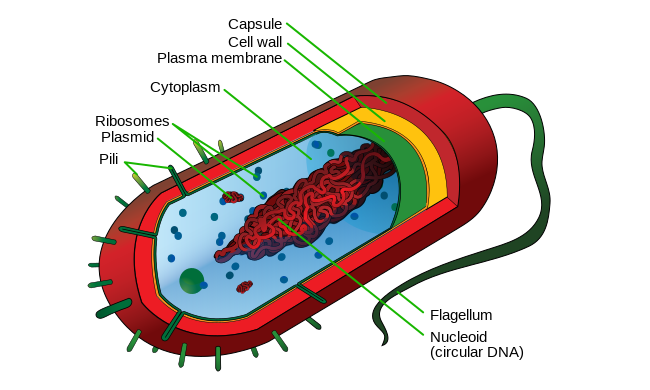
Prokaryotic cells, found in bacteria and archaea, have no nucleus. Their DNA is usually a single circular chromosome that sits in a region called the nucleoid. They have no membrane-bound organelles, and they are generally small. Many have a cell wall and some have a tail-like flagellum for movement. Some also have small extra rings of DNA called plasmids.
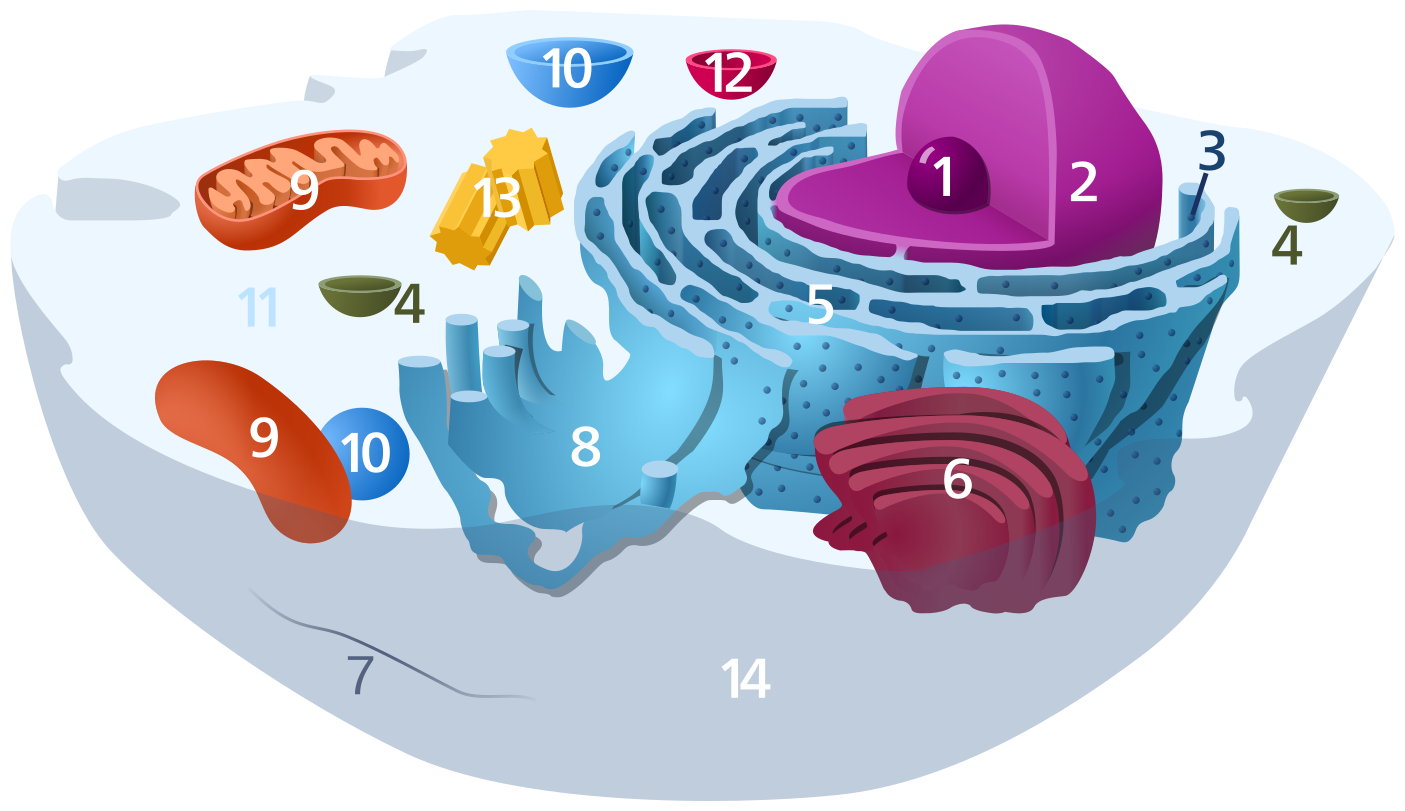
Eukaryotic cells, found in animals, plants, fungi and protists, have a nucleus that holds the DNA, and many membrane-bound organelles. They are usually much larger than prokaryotes. Each organelle makes a separate compartment where particular reactions can happen without interfering with others. This division of labor is the main reason eukaryotic cells can be so large and complex.
The organelles and their jobs
The nucleus stores DNA and is where RNA is made. The rough endoplasmic reticulum has ribosomes attached and makes proteins for export or for membranes. The smooth endoplasmic reticulum makes lipids and processes some chemicals. The Golgi apparatus modifies, sorts and packages proteins into vesicles. Lysosomes contain enzymes that break down worn-out parts and food, and they maintain an acidic interior for this job.
Mitochondria carry out cellular respiration and make most of the cell's ATP. They have a smooth outer membrane and a folded inner membrane, and the folds increase the surface area for ATP production. Chloroplasts are found in plants and algae and carry out photosynthesis. They contain stacks of membranes called thylakoids and a fluid called the stroma. Both mitochondria and chloroplasts have their own DNA, which is a clue about their origin that you will study in topic 2.10.
Plant cells have extra structures. A cell wall made of cellulose gives support, and a large central vacuole stores water and keeps the cell firm. Animal cells lack both, but they contain centrioles in many cases. The cytoskeleton of protein fibers, found in all eukaryotes, holds the cell's shape, anchors organelles and moves materials around.
Following a protein through the cell
Tracing a protein is a good way to remember the organelles. A gene in the nucleus is copied into mRNA, which leaves through a nuclear pore. A ribosome attached to the rough ER builds the protein and pushes it into the ER interior. A vesicle then carries it to the Golgi, which modifies it and packs it into a new vesicle. The vesicle fuses with the plasma membrane and releases the protein outside the cell.
This route is called the endomembrane system, and the connection between parts is why organelles are best learned together rather than as a list. You will meet it again in 2.9 when we study compartmentalization.
Worked example: what a damaged organelle would do
Imagine a mutation that stops the rough ER from attaching ribosomes. Proteins meant for the membrane or for secretion would be made in the cytoplasm instead, and they would not enter the ER. They would never reach the Golgi, so the cell could not secrete enzymes or place receptors in its membrane. The cell would still make cytoplasmic proteins, because free ribosomes are unaffected.
Now imagine that lysosomes leak. Their acidic enzymes would spill into the cytoplasm, but the cytoplasm is close to neutral pH, so many of the enzymes would work poorly. This is one reason the acid inside the lysosome is a safety feature. Predicting what fails when one part is removed is a favorite exam skill, so practice with each organelle.
Why it matters for the exam
Cell questions ask you to match a structure to a function or predict what would happen if a part failed. For example, a cell with damaged mitochondria would have less ATP, and a cell with damaged lysosomes would build up waste. Learn each organelle as a job, and name the job in your answer instead of only the structure.
You may also be shown a micrograph or diagram and asked to identify the cell type. Look for a nucleus and organelles for a eukaryote, and a cell wall and chloroplasts for a plant. This topic is the foundation of Unit 2, and every later topic in the unit builds on these parts.
Key takeaways
- All cells have a plasma membrane, cytoplasm, DNA and ribosomes.
- Prokaryotes lack a nucleus and membrane-bound organelles. Eukaryotes have both.
- The nucleus stores DNA, and ribosomes build proteins.
- Rough ER, Golgi and vesicles move and modify proteins.
- Mitochondria make ATP and chloroplasts carry out photosynthesis.
- Plant cells have a cell wall, a central vacuole and chloroplasts.
- Lysosomes digest materials, and the cytoskeleton gives shape and movement.
How this shows up on the exam
- Multiple choice: match an organelle to its function.
- Short answer: predict the effect of a damaged organelle.
- Diagram question: identify the cell type and its labeled parts.
- Reasoning skill: trace a protein through the cell.
Common mistakes
- Saying prokaryotes have no DNA. They have DNA, but it is not in a nucleus.
- Saying ribosomes are organelles with membranes. They have no membrane.
- Saying plant cells have no mitochondria. They have both mitochondria and chloroplasts.
- Saying the Golgi makes proteins. Ribosomes make them, and the Golgi modifies and sorts them.
Key terms
- plasma membrane
- cytoplasm
- ribosome
- nucleus
- nucleoid
- plasmid
- prokaryote
- eukaryote
- organelle
- rough ER
- smooth ER
- Golgi apparatus
- lysosome
- mitochondrion
- chloroplast
- cell wall
- central vacuole
- cytoskeleton
Check yourself
Topic 2.1 quiz
A cell secretes a large amount of protein. Which organelle is most likely to be abundant?