2.9 Compartmentalization
Membrane-bound organelles separate a eukaryotic cell into compartments. This lets many reactions run at once, each in its own best conditions.
Why divide a cell into rooms
A eukaryotic cell is much larger than a prokaryote and it runs hundreds of different reactions. If everything happened in one open space, the reactions would interfere with each other, and the cell would have trouble keeping the right conditions for each. Compartmentalization solves this by using membranes to create separate spaces called organelles. Each one has its own set of enzymes and its own chemical conditions.
Think of a kitchen with a separate bakery, freezer and dishwashing room. Each room has the equipment and temperature that its job needs, and the heat of the oven does not melt the ice cream. In a cell, the acidic interior of a lysosome would damage the rest of the cell if it were free, so a membrane keeps the digestive enzymes confined.
This design also helps with efficiency. Enzymes and substrates for one pathway are kept close together, so reactions happen faster. Compartments also let a cell store materials, keep harmful products away from DNA and carry out opposite reactions at the same time without undoing one another.
Membranes inside the cell
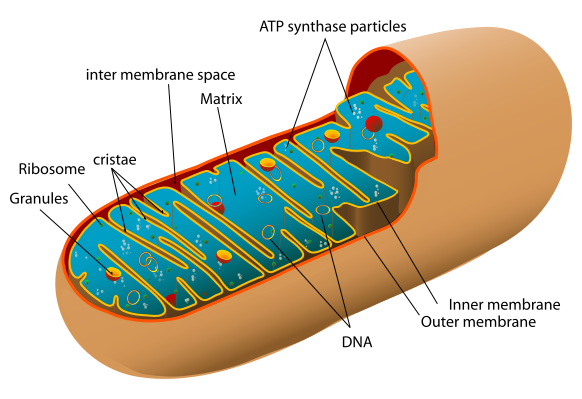
The internal membranes have the same basic structure as the plasma membrane, but they hold different proteins. This means each organelle can control what enters and leaves. The nuclear envelope is a double membrane with pores that controls the movement of mRNA and proteins. Mitochondria and chloroplasts also have two membranes, with the folded inner membrane holding the proteins that make ATP.
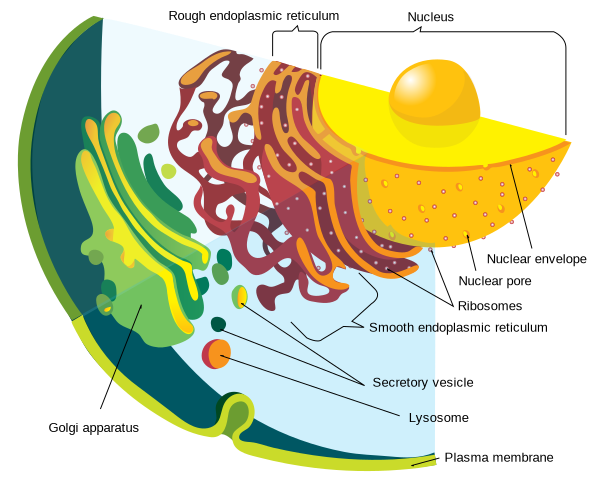
The endomembrane system is a group of related membranes that work together: the nuclear envelope, the endoplasmic reticulum, the Golgi apparatus, lysosomes, vesicles and the plasma membrane. Materials pass between them in vesicles that bud off from one membrane and fuse with the next. This is how a protein made at the rough ER can end up outside the cell.
Surface area inside organelles
Folded internal membranes hold more reactions. The cristae of a mitochondrion, which are folds of the inner membrane, greatly increase the space available for the electron transport chain and ATP synthase. The stacks of thylakoids in a chloroplast do the same for the light reactions. The more membrane there is, the more proteins fit in, and the more ATP or sugar the organelle can make.
This is the same idea as the surface area to volume ratio in topic 2.2. Folding lets a structure hold a large area within a small volume. The rough ER shows it too, with its flat sheets covered in ribosomes, which provides a large surface for protein production.
- Nucleus: protects DNA and controls what passes through its pores.
- Lysosome: keeps acidic digestive enzymes away from the rest of the cell.
- Mitochondrion: folded inner membrane increases the area for ATP production.
- Chloroplast: thylakoids hold the light reaction proteins.
- ER and Golgi: separate rooms for making and finishing proteins and lipids.
Compartments in prokaryotes and in the cell as a whole
Prokaryotes lack membrane-bound organelles, but they are not without organization. Their reactions can occur at the plasma membrane, which is folded in some bacteria, and some have protein-based compartments. Because prokaryotes are small, materials do not need to travel far, so they do not need as many internal rooms.
Even in eukaryotes, compartments are not completely sealed. Vesicles, channels and pores allow controlled exchange. The key point is that the cell controls the traffic between compartments, which is what makes the arrangement an advantage and not simply a barrier.
Worked example: explaining a structure-function link
A question shows two cells. Cell 1 is a liver cell with a large amount of smooth ER and many mitochondria. Cell 2 is a cell of the pancreas that secretes digestive enzymes and has a large amount of rough ER and Golgi. Ask what each cell does a lot of. The liver cell detoxifies chemicals, processes lipids and needs a lot of energy, which fits smooth ER and mitochondria. The pancreas cell makes and exports proteins, which fits rough ER and Golgi.
This approach works for any cell. Look at the organelles that are abundant and ask which job needs them. Cells with many mitochondria are active, cells with many chloroplasts are photosynthetic, and cells with a lot of rough ER and Golgi are secretory. Compartments are what allow each cell type to specialize in this way.
Why it matters for the exam
Questions often ask you to explain how an organelle's structure supports its function, or what would happen if a membrane failed. A strong answer links the membrane to a specific benefit, such as separating conditions, increasing surface area or keeping harmful enzymes contained.
This topic also sets up energy in Unit 3, because ATP production in mitochondria and photosynthesis in chloroplasts both depend on internal membranes. You will see how the folded membranes hold a proton gradient, which is how the cell turns the energy of food and light into ATP.
Key takeaways
- Compartmentalization uses membranes to make separate spaces in a cell.
- Each organelle can have its own enzymes and conditions.
- Separation keeps harmful reactions away from the rest of the cell.
- Folded membranes such as cristae and thylakoids increase surface area.
- The endomembrane system passes materials by vesicles.
- Prokaryotes are small and have no membrane-bound organelles.
- The cell controls traffic between compartments.
How this shows up on the exam
- Multiple choice: match a feature to its advantage.
- Short answer: explain why lysosomes are enclosed.
- Diagram question: identify the membrane that increases surface area.
- Reasoning skill: predict the effect of a leaking membrane.
Common mistakes
- Saying compartments isolate everything completely. Controlled exchange continues.
- Saying prokaryotes have no organization. They have organized regions.
- Saying folding makes an organelle bigger. It increases the surface area within the same volume.
- Saying the endomembrane system includes mitochondria. It does not.
Key terms
- compartmentalization
- organelle
- endomembrane system
- nuclear envelope
- cristae
- thylakoid
- vesicle
- surface area
- lysosome
- inner membrane
Check yourself
Topic 2.9 quiz
Why is it an advantage for lysosomes to be surrounded by a membrane?