2.8 Mechanisms of Transport
Active transport uses energy to move substances against a gradient, and bulk transport uses vesicles to move large particles. Both let cells build up concentrations that diffusion would not.
Active transport: moving uphill
Active transport moves a substance from a region of lower concentration to a region of higher concentration. This is against the gradient, like pushing a ball uphill, so it needs energy. The energy usually comes from ATP. The transport proteins that do this are called pumps, and they are specific, which means each pump moves only certain molecules.
Active transport is how cells maintain concentrations that are very different from their surroundings. Without it, ions would leak across the membrane until the inside and outside were equal. Animal cells keep a high level of potassium inside and a high level of sodium outside, and they do so by active transport. These gradients are the energy source for many other cell processes.
A simple way to remember: if the molecule goes from low to high concentration, or if ATP is used, think active transport. If it goes from high to low through a protein with no ATP, think facilitated diffusion.
The sodium-potassium pump
The sodium-potassium pump is the classic example. It is a carrier protein in the plasma membrane of animal cells. In each cycle it moves three sodium ions out of the cell and two potassium ions into the cell, using the energy from one ATP. A phosphate from the ATP attaches to the pump and changes its shape, which releases sodium outside. When the phosphate leaves, the pump returns to its first shape and potassium is released inside.
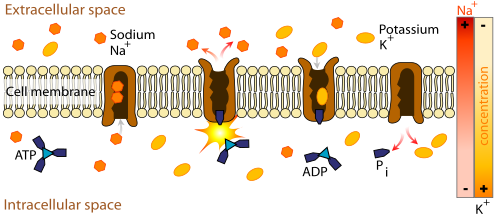
The pump creates both a chemical gradient and an electrical one. Because it moves three positive charges out and two in, the inside of the cell becomes slightly negative. Nerve cells depend on this for sending signals. The pump uses a large share of the ATP in many animal cells, which shows how important the gradient is.
Cotransport: using one gradient for another
Some active transport uses an existing gradient instead of ATP directly. In cotransport, the downhill movement of one substance powers the uphill movement of another through the same carrier. A common example is a protein that moves sodium into the cell down its gradient and brings glucose in at the same time, even if the glucose concentration inside is higher.
This is sometimes called secondary active transport. The cell still spends energy in an indirect way, because the sodium-potassium pump uses ATP to build the sodium gradient in the first place. Intestinal cells use this to absorb glucose. In plants, cells use a proton gradient in a similar way to bring in sugars, which is a good reminder that this strategy is used across life.
Bulk transport with vesicles
Large molecules and whole particles cannot pass through proteins, so cells move them in vesicles. In endocytosis, the plasma membrane folds inward and pinches off to bring material into the cell. Phagocytosis takes in large particles or whole cells, and white blood cells use it to engulf bacteria. Pinocytosis takes in droplets of fluid. Receptor-mediated endocytosis brings in specific molecules that bind to receptors on the surface first.
In exocytosis, a vesicle fuses with the plasma membrane and releases its contents outside the cell. Cells use this to secrete proteins such as digestive enzymes and hormones. It also adds membrane to the cell surface, which links back to the endomembrane system. Both endocytosis and exocytosis need energy, because they involve reshaping the membrane and moving vesicles along the cytoskeleton.
Worked example: telling the types of transport apart
A cell has a high potassium concentration inside, and the outside concentration is low. A researcher notes that potassium keeps flowing in even when the outside concentration is much lower than the inside concentration, and that this stops when a poison blocks ATP production. This is active transport, since potassium goes against its gradient and needs energy. If instead potassium moved in only when the outside level was higher, and ATP made no difference, it would be diffusion through a channel.
Now picture a white blood cell surrounding a bacterium and drawing it inside in a vesicle. This is phagocytosis, a form of endocytosis. A neuron releasing neurotransmitter from vesicles into a synapse is exocytosis. Use three questions as a checklist: which way is the gradient, is energy used and is a vesicle involved? Those three answers sort every transport scenario you will see.
Why it matters for the exam
Transport questions often give a description or a graph and ask you to identify the type. Look for clues. If the substance moves against its gradient, or if the data show a drop when the cell is poisoned so that it cannot make ATP, the process is active. If a vesicle is mentioned, think bulk transport.
You should be able to explain why the sodium-potassium pump matters and to describe at least one example of endocytosis and one of exocytosis. The pump also connects to nerve signals and to the fact that cells keep different ion concentrations inside and out. Both ideas return in Unit 4 and Unit 8.
Key takeaways
- Active transport moves substances against their gradient using energy.
- The sodium-potassium pump moves three sodium out and two potassium in using ATP.
- Cotransport uses one substance's gradient to move another.
- Endocytosis brings material in with vesicles.
- Exocytosis sends material out with vesicles.
- Phagocytosis engulfs large particles. Pinocytosis takes in fluid.
- Pumps create gradients that nerve cells and other cells use.
How this shows up on the exam
- Multiple choice: name the type of transport.
- Short answer: explain the role of ATP in the pump.
- Data question: transport rate after a metabolic poison.
- Reasoning skill: justify why a process needs energy.
Common mistakes
- Saying active transport moves substances down the gradient. It moves them against it.
- Saying the pump moves equal numbers of ions. It moves three out and two in.
- Saying vesicles are used for ions. They are used for large materials.
- Saying exocytosis needs no energy. It does.
Key terms
- active transport
- sodium-potassium pump
- ATP
- cotransport
- endocytosis
- exocytosis
- phagocytosis
- pinocytosis
- receptor-mediated endocytosis
- vesicle
- pump
- bulk transport
Check yourself
Topic 2.8 quiz
Cells treated with a poison that stops ATP production can no longer keep potassium concentrated inside. This best shows that potassium uptake is...