2.3 Plasma Membranes
The plasma membrane is a fluid mosaic of phospholipids, cholesterol and proteins. It separates the cell from its surroundings and controls what passes through.
The fluid mosaic model
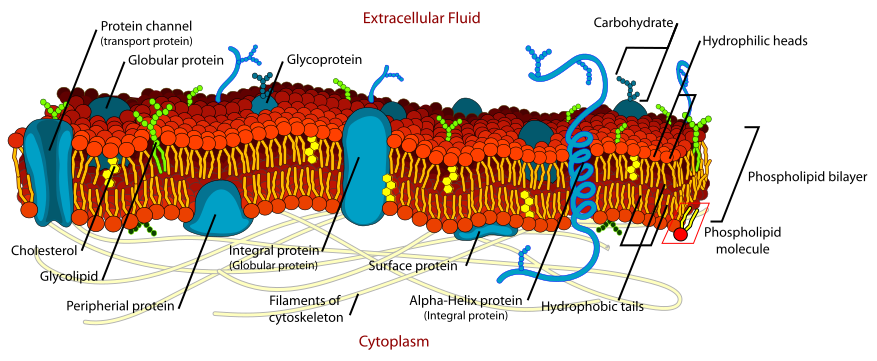
The fluid mosaic model describes the membrane as a flexible layer in which many different molecules float and move sideways. It is fluid because the phospholipids are not locked in place. They slide past each other, and proteins drift among them. It is a mosaic because it is made of many different pieces, including phospholipids, cholesterol, proteins and carbohydrates, arranged like tiles in a picture.
The basic structure is the phospholipid bilayer from topic 1.5. The hydrophilic heads face the watery fluid inside and outside the cell, and the hydrophobic tails form a nonpolar interior. This arrangement means the membrane acts as a barrier to ions and large polar molecules, while small nonpolar molecules can pass through. Everything else the membrane does is added by the other components.
The parts and their jobs
Cholesterol sits between phospholipids in animal cell membranes. At warm temperatures it keeps the membrane from becoming too fluid, and at cool temperatures it prevents the tails from packing too tightly. In this way, cholesterol helps the membrane stay flexible across a range of temperatures.
Integral proteins span the membrane, and peripheral proteins attach to its surface. They do most of the membrane's work. Some form channels or carriers for transport, some are receptors that bind signals, some are enzymes, and some attach the cell to its neighbors or to the cytoskeleton. Proteins that cross the membrane have nonpolar regions that sit in the lipid core and polar regions that face the water.
Carbohydrates attach to proteins and lipids on the outer surface, forming glycoproteins and glycolipids. They act as identification tags that cells use to recognize each other. This is how the immune system tells your own cells from invaders, and it is why blood types differ. The carbohydrate chains always face the outside of the cell.
Fluidity and what changes it
Membrane fluidity depends on the fatty acid tails. Saturated tails are straight and pack tightly, so the membrane is less fluid. Unsaturated tails have kinks that keep the lipids apart, so the membrane is more fluid. Cells that live in cold environments often have more unsaturated fatty acids in their membranes, which prevents the membrane from becoming stiff.
Temperature also matters. When it gets colder, the phospholipids move more slowly and pack closer together, and the membrane becomes stiffer. When it gets warmer, they move faster and the membrane becomes more fluid. A membrane that is too stiff or too fluid cannot control transport properly, so cells adjust their lipid makeup when the temperature changes.
Membrane features at a glance
- Phospholipid bilayer: forms the barrier with a hydrophobic core.
- Cholesterol: buffers fluidity against temperature changes.
- Integral proteins: cross the membrane and form channels, carriers and receptors.
- Peripheral proteins: attach to the surface and often link to the cytoskeleton.
- Glycoproteins and glycolipids: act as identification tags on the outer surface.
- Selective permeability: only some substances pass freely, and the rest need help.
Worked example: designing a membrane experiment
Suppose a student wants to test how temperature affects membrane permeability using beet root pieces, which contain a red pigment inside their cells. The student places equal pieces in tubes of water at 10, 25, 40, 55 and 70 degrees Celsius for the same time, removes the pieces and measures how much red pigment leaked into the water with a colorimeter. The independent variable is temperature, the dependent variable is the amount of pigment released, and the controls are the size of the pieces, the volume of water and the time.
Pigment release will probably rise slowly at first and then jump sharply at the higher temperatures, because high heat damages membrane proteins and disrupts the bilayer, so the membrane leaks. A good conclusion states the trend, links it to membrane structure and notes how the result would be more reliable with repeated trials and an average.
Why it matters for the exam
Membrane questions often show a diagram and ask you to label or explain it. You should be able to say which parts are hydrophobic and which are hydrophilic, and why proteins with nonpolar regions are held in the bilayer. An experiment may change the temperature or the type of fatty acid, and you should predict the change in fluidity and explain it by the packing of the tails.
This topic leads directly into transport in topics 2.4 to 2.8, because the structure of the membrane explains what can and cannot cross. It also connects to signaling in Unit 4, where receptor proteins in the membrane detect messages from other cells.
Key takeaways
- The fluid mosaic model describes a flexible bilayer with embedded molecules.
- Phospholipids form a barrier with a hydrophobic core.
- Cholesterol helps keep fluidity steady as temperature changes.
- Integral proteins span the membrane, and peripheral proteins sit on the surface.
- Membrane proteins act as channels, carriers, receptors and enzymes.
- Carbohydrates on the surface identify the cell.
- Unsaturated fatty acids make the membrane more fluid.
How this shows up on the exam
- Multiple choice: identify a membrane part from a diagram.
- Short answer: explain the effect of temperature on fluidity.
- Data question: membrane permeability at different conditions.
- Reasoning skill: relate membrane structure to function.
Common mistakes
- Saying the membrane is a solid wall. It is fluid and flexible.
- Saying cholesterol makes the membrane more rigid in every case. It buffers fluidity.
- Saying carbohydrates are inside the cell membrane. They are on the outer surface.
- Saying all proteins span the membrane. Peripheral proteins do not.
Key terms
- fluid mosaic model
- phospholipid
- bilayer
- cholesterol
- integral protein
- peripheral protein
- glycoprotein
- glycolipid
- selective permeability
- fluidity
- receptor
- channel protein
- carrier protein
Check yourself
Topic 2.3 quiz
A cell lives in a cold environment. Which change in its membrane would help it stay fluid?