2.6 Facilitated Diffusion
Channel and carrier proteins let ions and polar molecules cross the membrane down their gradients without using energy from the cell.
Why some molecules need help
Topic 2.4 showed that ions and large polar molecules cannot cross the hydrophobic core of the bilayer. They still need to enter and leave cells, and the cell solves this problem with transport proteins. In facilitated diffusion, a protein provides a pathway across the membrane, and the molecule moves down its concentration gradient. The cell does not spend ATP, because the gradient supplies the push.
This is still passive transport. The protein does not pump anything uphill. It only makes the downhill trip possible. If you compare a dam with a gate in it, the water flows because of the height difference, and the gate just decides whether it can go. In the same way, the protein opens a route while the gradient drives the movement.
Facilitated diffusion is specific. A glucose carrier moves glucose and not other sugars, and a potassium channel lets potassium pass but not sodium. This specificity comes from the shape of the protein, which links back to the idea that structure determines function.
Channel proteins and carrier proteins
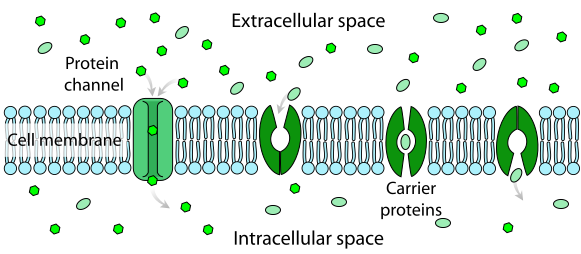
A channel protein forms a tunnel through the membrane. Many channels are gated, which means they open or close in response to a signal such as a change in voltage or the binding of a molecule. Ion channels in nerve cells are a good example, and they are the reason a neuron can send a signal. Aquaporins are channels that let water pass quickly.
A carrier protein, also called a transporter, binds to the molecule it moves. After binding, the carrier changes shape and releases the molecule on the other side. It then returns to its original shape and can bind another molecule. Because each molecule must bind, carriers work more slowly than channels, and they can become saturated.
Saturation: a limit on the rate
Because a carrier protein must bind to each molecule, the rate of transport has an upper limit. When the concentration outside is low, adding more molecules increases the rate, since there are free carriers waiting. When the concentration gets high enough that all the carriers are busy, adding more molecules does not speed things up. The system is saturated.
A graph of rate against concentration shows this clearly. For simple diffusion, the line keeps rising in a straight line as concentration increases. For facilitated diffusion by a carrier, the curve rises and then levels off at a maximum. If the graph levels off, the cause is a limited number of proteins, and that is the clue to look for on the exam.
A cell can raise the maximum rate by adding more transport proteins to its membrane. This is how cells adjust to changing needs, for instance when muscle cells add glucose transporters in response to insulin.
Facilitated diffusion in the body
Glucose enters most body cells by facilitated diffusion. The concentration of glucose in the blood is higher than inside cells, since cells use it as soon as it arrives. Carrier proteins move it in down the gradient. In people with diabetes, this process fails to respond properly to insulin, and so the cells cannot take up glucose even when the blood has plenty.
Nerve cells use gated ion channels to send signals. Opening and closing channels lets sodium and potassium ions flow down their gradients, which changes the electrical charge across the membrane. Red blood cells use aquaporins for fast water movement. In each case, a protein turns a blocked route into a controlled one.
Worked example: carriers and channels in a graph
A student measures how fast a cell takes up two substances at increasing outside concentrations. For substance X, uptake rises in a straight line as concentration increases. For substance Y, uptake rises quickly at low concentration and then flattens at a maximum. Substance X is most likely moving by simple diffusion across the bilayer, because there is no upper limit. Substance Y is most likely moving by a carrier protein, which can be saturated.
To test this idea, the student could add a chemical that blocks the carrier. Uptake of Y would fall sharply while uptake of X would stay about the same. If the cell is then starved of ATP and Y uptake is unchanged, the process does not need energy and is facilitated diffusion rather than active transport. Two simple tests, a blocker and an energy check, separate all three types of transport.
Why it matters for the exam
Exam questions ask you to tell facilitated diffusion apart from simple diffusion and from active transport. The key points are that it needs a protein, that it follows the gradient, and that it uses no ATP. If a graph levels off, think carriers and saturation. If a molecule moves against its gradient, it is not facilitated diffusion.
This topic is a bridge. It is passive like diffusion, but it uses proteins like active transport. Being clear about the difference will help you with 2.7 on osmosis and 2.8 on active transport.
Key takeaways
- Facilitated diffusion moves molecules down a gradient through transport proteins.
- It does not need ATP.
- Channel proteins form pores, and many are gated.
- Carrier proteins bind a molecule and change shape.
- Carriers can become saturated, which limits the rate.
- Specificity comes from the shape of the protein.
- Glucose, ions and water often use these proteins.
How this shows up on the exam
- Multiple choice: identify the type of transport from a description.
- Graph question: explain why a rate levels off.
- Short answer: compare channels and carriers.
- Reasoning skill: justify why ATP is not needed.
Common mistakes
- Saying facilitated diffusion uses ATP. It does not.
- Saying proteins move molecules against the gradient in facilitated diffusion. They go down it.
- Saying channels become saturated in the same way as carriers. Carriers show saturation more clearly.
- Saying any protein will move any molecule. Transport proteins are specific.
Key terms
- facilitated diffusion
- channel protein
- carrier protein
- gated channel
- aquaporin
- saturation
- transport protein
- passive transport
- specificity
Check yourself
Topic 2.6 quiz
The rate of glucose uptake rises with glucose concentration and then levels off. Which best explains the plateau?