3.1 Enzymes
Enzymes are protein catalysts that lower the activation energy of reactions. Each fits one substrate, which is why cells can run thousands of reactions at body temperature.
Why cells need catalysts
Chemical reactions need a push to get started, and that push is called the activation energy. Many reactions in a cell would be far too slow at body temperature without help. A catalyst speeds up a reaction by lowering the activation energy, and it is not used up. In cells, the catalysts are enzymes, and almost all of them are proteins.
An enzyme does not change the energy of the reactants or the products, and it does not change whether a reaction can happen. It only changes how fast the reaction reaches equilibrium. A reaction that releases energy still releases the same amount with or without the enzyme. It just gets there much sooner.
Think of a ball sitting behind a small hill that must be pushed over before it rolls downhill. The enzyme does not change the height of the bottom of the slope. It shortens the hill, so less push is needed.
The active site and the substrate
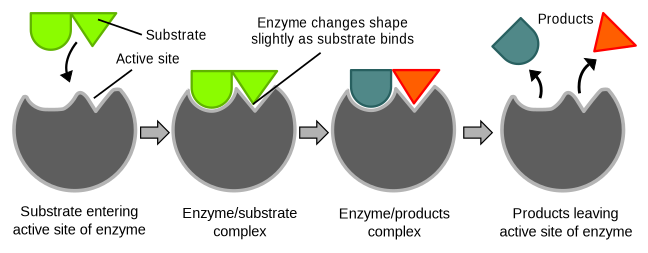
The molecule that an enzyme acts on is the substrate. The substrate binds to a small region of the enzyme called the active site. The active site has a shape and chemical makeup that matches its substrate, and this is why each enzyme is specific. The enzyme and substrate join to form an enzyme-substrate complex, the reaction takes place, and the products are released. The enzyme is free to work again.
The original picture of this was the lock and key model, in which the substrate fits the active site perfectly. A better description is the induced fit model, in which the active site changes shape slightly when the substrate binds, making a tighter fit. This change in shape strains the bonds of the substrate and helps the reaction along.
How enzymes lower activation energy
Enzymes use several tricks. They can hold two substrates close together in the right orientation, so the reaction does not rely on a lucky collision. They can strain a bond in the substrate until it is easier to break. They can provide a special chemical environment in the active site, such as a patch of charge, that helps the reaction. In some cases they pass atoms to and from the substrate temporarily.
A graph of energy against reaction progress shows two humps. The uncatalyzed reaction has a high hump, and the catalyzed reaction has a lower one. The starting and ending levels are the same in both. Being able to draw and explain this graph is a common exam skill. If the exam asks what an enzyme changes, the answer is the height of the hump.
The relationship between substrate and enzyme also explains reaction rates. When there is a lot of substrate and few enzymes, adding more substrate does not increase the rate, because all active sites are busy. This is saturation, the same idea you met with carrier proteins in topic 2.6.
Enzymes in the cell
Enzymes often work in sequences called metabolic pathways, in which the product of one enzyme becomes the substrate of the next. Glycolysis, which you will study in 3.5, has ten steps and each uses a different enzyme. Because the enzymes are specific, the cell can control which pathways run by controlling which enzymes are present and active.
Many enzyme names end in -ase, such as lipase, which acts on lipids, and DNA polymerase, which builds DNA. Some enzymes need helper molecules. A cofactor is a metal ion or other non-protein helper. An organic helper is called a coenzyme, and many vitamins are used to make coenzymes. This is why a lack of certain vitamins can lead to illness.
- Catalyst: speeds up a reaction without being used up.
- Activation energy: the push needed to start a reaction.
- Substrate: the molecule the enzyme acts on.
- Active site: the region where the substrate binds.
- Induced fit: the active site adjusts its shape around the substrate.
- Cofactor and coenzyme: helpers needed by some enzymes.
Worked example: an energy diagram
Picture a graph with reaction progress on the horizontal axis and energy on the vertical axis. The reactants start at a certain level, climb a hill, and the products end at a lower level. The height of the hill above the reactants is the activation energy. With an enzyme, the hill is lower, but the reactants and products stay at the same levels. The drop from reactants to products is the same in both cases, so the amount of energy released does not change.
If a question asks what happens to the rate when an enzyme is added, say that the lower hill means more molecules have enough energy to react, so the reaction goes faster. If it asks what happens to the equilibrium position, say that it does not change. Many students lose points by saying the enzyme provides energy or changes the products.
Why it matters for the exam
Enzyme questions often ask you to explain what an enzyme does and what it does not do. Remember that it lowers activation energy, does not change the overall energy released, is not used up and is specific because of its active site shape. Many free-response questions give a graph and ask what a change would do.
This topic leads to 3.2, which covers how temperature, pH and inhibitors change enzyme activity, and to 3.3 to 3.5, where almost every step in energy metabolism is run by an enzyme.
Key takeaways
- Enzymes are protein catalysts that lower activation energy.
- An enzyme is not used up and does not change the overall energy released.
- The substrate binds to the active site to form an enzyme-substrate complex.
- Induced fit means the active site changes shape slightly.
- Enzymes are specific because of the shape and chemistry of the active site.
- Enzymes often work in pathways.
- Cofactors and coenzymes help some enzymes.
How this shows up on the exam
- Multiple choice: identify what an enzyme changes.
- Graph question: draw or interpret an energy diagram.
- Short answer: explain enzyme specificity.
- Reasoning skill: predict the effect of changing substrate.
Common mistakes
- Saying enzymes are used up. They are reusable.
- Saying enzymes change the energy of the products. They lower the activation energy only.
- Saying enzymes make impossible reactions happen. They speed up reactions that are possible.
- Saying all enzymes work on any substrate. Each is specific.
Key terms
- enzyme
- catalyst
- activation energy
- substrate
- active site
- enzyme-substrate complex
- induced fit
- product
- cofactor
- coenzyme
- metabolic pathway
- specificity
Check yourself
Topic 3.1 quiz
What does an enzyme change in a reaction?