3.2 Environmental Impacts on Enzyme Function
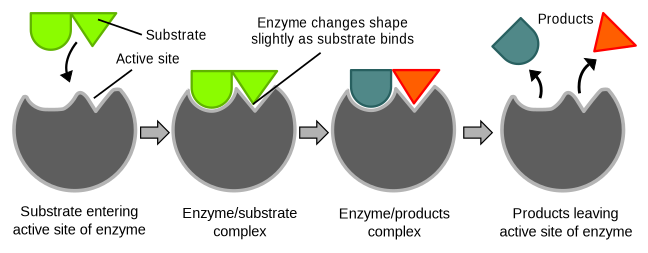
Temperature, pH and inhibitors change how well an enzyme works. These effects follow from how they alter the enzyme's shape and its active site.
Temperature
As temperature rises, molecules move faster and collide more often, so an enzyme-catalyzed reaction speeds up. This continues until an optimum temperature, at which the rate is highest. For human enzymes, this is close to 37 degrees Celsius. Above the optimum, the heat disrupts the bonds that hold the enzyme in shape, and the active site loses its fit. The enzyme denatures, and the rate drops sharply.
A graph of rate against temperature is therefore a hill-shaped curve that rises slowly and then falls steeply. The fall is steeper than the rise because denaturation is a rapid loss of function. At very low temperatures, an enzyme does not denature, but it works very slowly because molecules move slowly. Warming it again restores activity.
Different organisms have different optima. Enzymes of bacteria that live in hot springs work best at very high temperatures, and enzymes of arctic fish work best in the cold. In each case, the shape of the enzyme matches the environment it lives in.
pH
Every enzyme also has an optimum pH. A change in pH alters the charges on the R groups of amino acids, which affects the ionic bonds and hydrogen bonds that hold the enzyme's shape. If the pH moves too far from the optimum, the active site changes shape and the enzyme denatures. The graph is again a hill-shaped curve, this time with the rate plotted against pH.
Optimum pH matches the location of the enzyme. Pepsin works in the stomach and has an optimum near pH 2, which is very acidic. Most enzymes in the cell work near pH 7. Enzymes of the small intestine work at a slightly basic pH, around 8. If you put an enzyme in the wrong place, it will work poorly or not at all.
Inhibitors
An inhibitor is a molecule that reduces the activity of an enzyme. A competitive inhibitor looks like the substrate and binds to the active site, which blocks the substrate. Adding more substrate can overcome this kind of inhibition, because the substrate has a better chance of reaching the active site. Maximum rate can still be reached at a high substrate concentration.
A noncompetitive inhibitor binds at a different place on the enzyme, called an allosteric site. The binding changes the shape of the enzyme, including the active site, so the substrate fits poorly or not at all. Adding more substrate does not fix this, because the inhibitor is not blocking the active site directly. The maximum rate becomes lower.
Many medicines are inhibitors. Some antibiotics block bacterial enzymes, and some drugs for high blood pressure block an enzyme in the human body. Inhibitors can also be natural. The cell uses them to control its own pathways, which is the idea behind feedback inhibition in 3.3 and Unit 4.
Reading enzyme graphs and experiments
In an enzyme experiment, the independent variable is the thing you change, such as temperature, and the dependent variable is the rate, measured as the amount of product made per minute or the amount of substrate used. Controls keep the other conditions the same. Each enzyme should be tested at several values to find the peak.
To tell the inhibitors apart on a graph of rate against substrate, look at what happens at high substrate concentration. If the line with the inhibitor eventually reaches the same maximum as the line without it, the inhibitor is competitive. If its maximum stays lower, it is noncompetitive. This is a very common question.
Worked example: an enzyme experiment
A student tests catalase from liver, which breaks hydrogen peroxide into water and oxygen, at pH 3, 5, 7, 9 and 11. The oxygen produced in thirty seconds is measured by the height of foam in a tube. The foam is 1, 4, 9, 5 and 1 centimeters. The peak at pH 7 shows the optimum, and the low values at the extremes show denaturation. The independent variable is pH, the dependent variable is foam height, and the controls include the amount of liver, the volume of peroxide and the temperature.
A good conclusion says that catalase works best near neutral pH, links the drop on either side to changes in the shape of the active site, and mentions that repeated trials would reduce error. If the student boiled the liver first, foam would be close to zero at every pH, because heat denatures the enzyme. That is a useful negative control.
Why it matters for the exam
Explain every change by its effect on the shape of the active site. If an enzyme works less well, say what changed, how it changed the shape, and what happened to the substrate binding. Do not just say it stopped working, which does not earn credit.
Enzymes are central to the rest of Unit 3, because each step in photosynthesis and respiration is controlled by an enzyme, and to Unit 4, where feedback controls change the activity of enzymes.
Key takeaways
- Each enzyme has an optimum temperature and pH.
- Above the optimum, enzymes denature and lose their active site shape.
- Low temperatures slow enzymes but do not usually denature them.
- Competitive inhibitors bind the active site and can be overcome with more substrate.
- Noncompetitive inhibitors bind elsewhere and change the shape of the active site.
- Noncompetitive inhibitors lower the maximum rate.
- Always link changes in activity to changes in shape.
How this shows up on the exam
- Multiple choice: read a rate versus temperature graph.
- Short answer: explain the effect of pH on an enzyme.
- Data question: distinguish inhibitor types from a graph.
- Reasoning skill: justify a prediction using active site shape.
Common mistakes
- Saying cold destroys an enzyme. It slows it down, and warming restores activity.
- Saying a competitive inhibitor cannot be overcome. More substrate can overcome it.
- Saying denaturing breaks peptide bonds. It breaks the weaker bonds that hold the shape.
- Saying all enzymes work best at 37 degrees. Each has its own optimum.
Key terms
- optimum temperature
- optimum pH
- denature
- inhibitor
- competitive inhibitor
- noncompetitive inhibitor
- allosteric site
- rate of reaction
- independent variable
- dependent variable
Check yourself
Topic 3.2 quiz
In an experiment, an inhibitor reduces enzyme activity at low substrate concentration, but at very high substrate concentration the rate reaches the same maximum as without the inhibitor. What type is it?