3.5 Cellular Respiration
Cellular respiration releases the energy in glucose to make ATP. Glycolysis, the Krebs cycle and the electron transport chain work in sequence, and fermentation is the backup when oxygen is missing.
The big picture
Cellular respiration breaks down glucose to release energy and uses it to make ATP. With oxygen, the overall reaction is glucose plus oxygen producing carbon dioxide and water, with energy captured as ATP. It is basically the reverse of photosynthesis in terms of matter, though the pathways are different. All living cells do respiration, including plants, which means plants carry out both processes.
The process has four stages in aerobic respiration: glycolysis, pyruvate oxidation, the Krebs cycle and the electron transport chain. Each stage passes along electrons and energy. Many of the electrons are carried by the coenzymes NADH and FADH2, which deliver them to the electron transport chain where most ATP is made.
A typical cell makes about 30 ATP from each glucose, though the number depends on the cell and the conditions. Most of this comes from the last stage, which makes it the most important for the energy yield.
Glycolysis
Glycolysis takes place in the cytoplasm and does not need oxygen. It splits one six-carbon glucose into two three-carbon molecules of pyruvate. It uses two ATP early on, and later makes four ATP, which gives a net gain of two ATP. It also makes two NADH. Because it is found in nearly all living things, it is likely one of the oldest metabolic pathways.
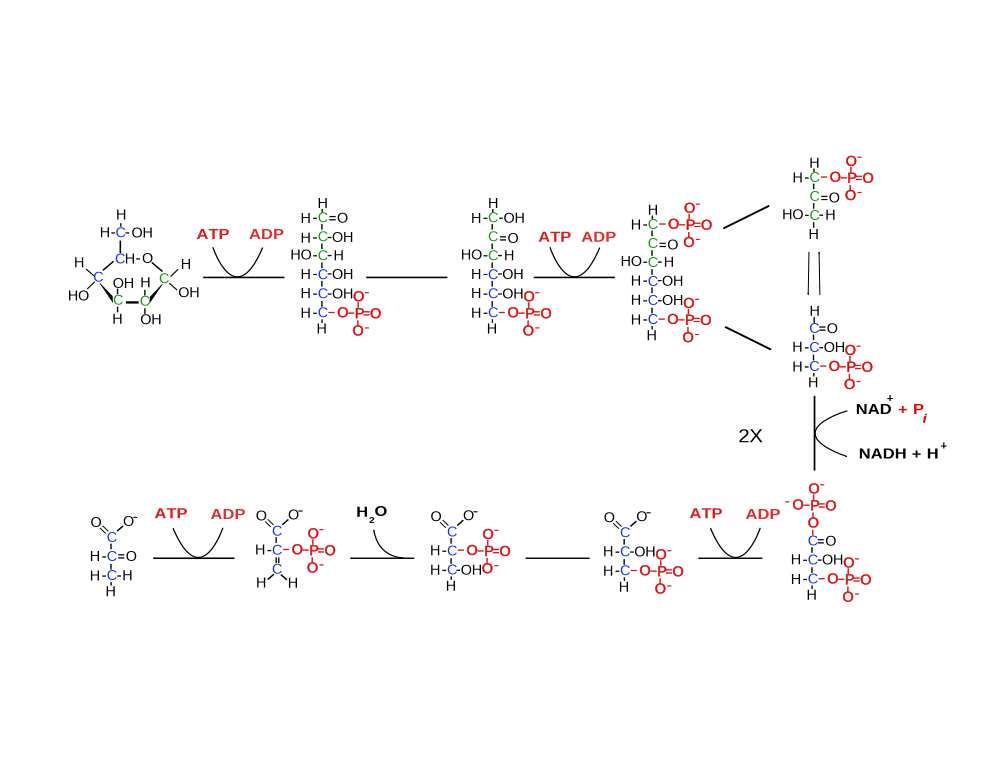
The ATP in glycolysis is made by substrate-level phosphorylation, in which a phosphate group is moved directly from a substrate to ADP by an enzyme. This is different from the way ATP is made later, and it makes only a small amount of ATP.
Pyruvate oxidation and the Krebs cycle
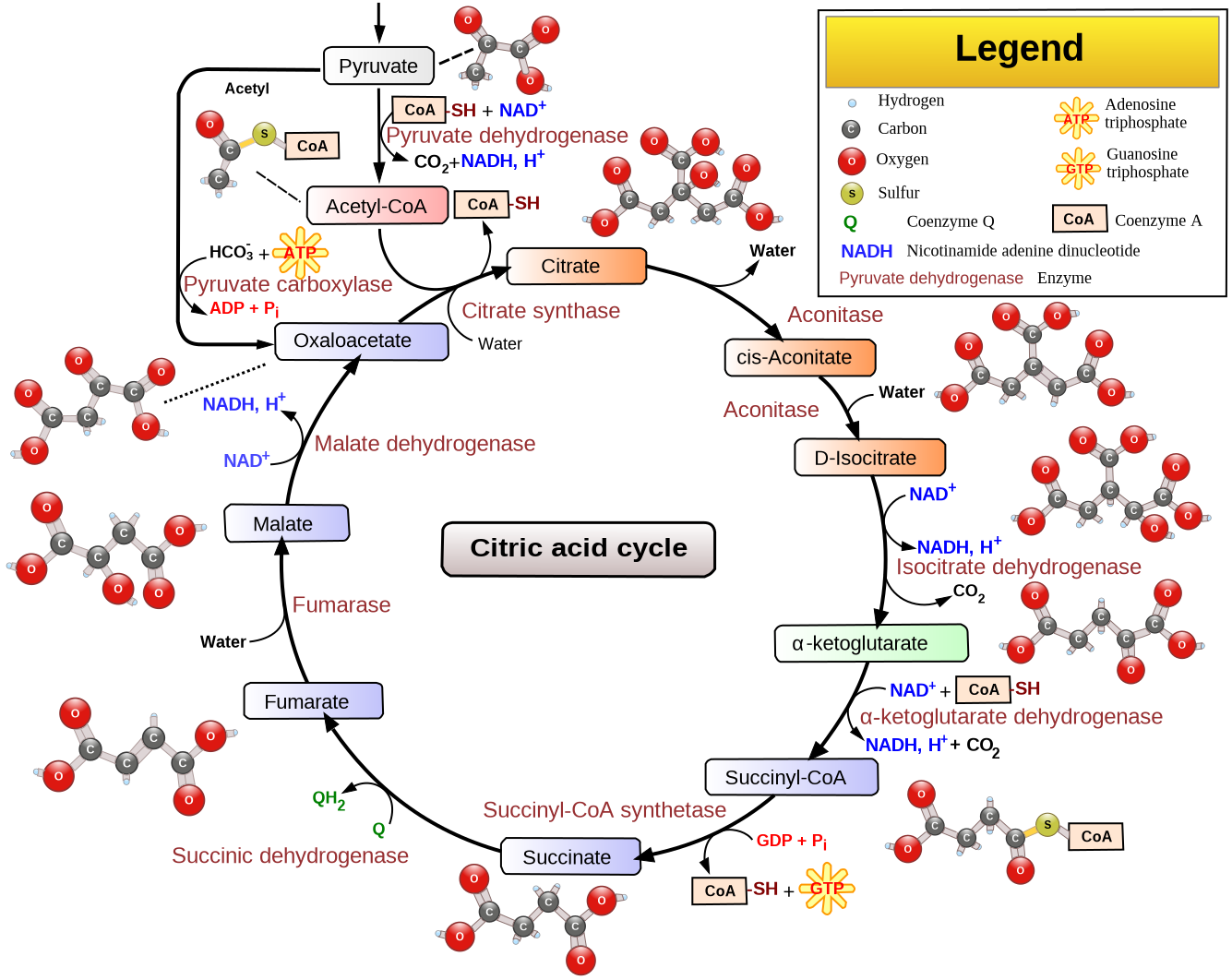
If oxygen is present, pyruvate enters the mitochondrion. There it is converted to a two-carbon molecule called acetyl CoA, and one carbon is released as carbon dioxide. NADH is also made. This step links glycolysis to the Krebs cycle, and it takes place in the mitochondrial matrix.
The Krebs cycle, also called the citric acid cycle, takes place in the matrix. Acetyl CoA joins a four-carbon molecule and goes around a series of steps that release the remaining carbon as carbon dioxide. For each glucose, the cycle turns twice, and the total yield is two ATP, six NADH and two FADH2, plus carbon dioxide. Nearly all of the carbon in the original glucose leaves as carbon dioxide by now.
The electron transport chain and chemiosmosis
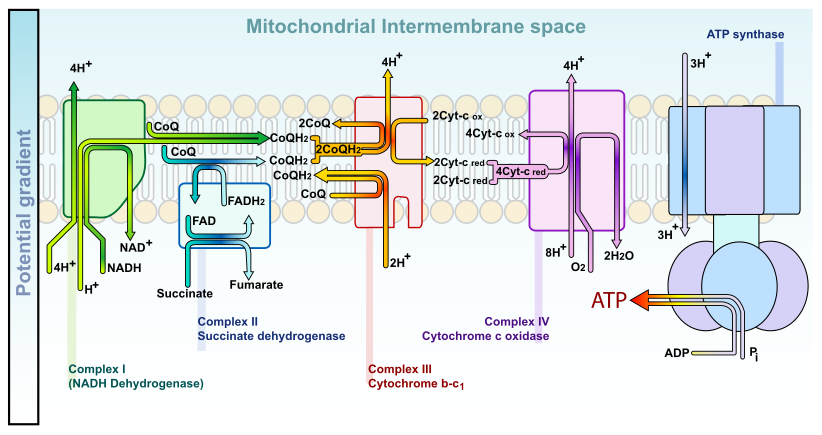
The electron transport chain is a set of proteins in the inner mitochondrial membrane, the cristae. NADH and FADH2 give up their electrons to the chain. As the electrons pass from protein to protein, they release energy that is used to pump hydrogen ions from the matrix into the space between the two membranes. This builds a proton gradient.
At the end of the chain, the electrons are accepted by oxygen, which combines with hydrogen ions to form water. This is why oxygen is needed. Without it, the chain backs up and the whole process stops. The protons then flow back into the matrix through ATP synthase, and the energy of their flow makes ATP by chemiosmosis. This stage makes the large majority of the ATP.
Fermentation: when oxygen is missing
Without oxygen, the electron transport chain stops, and NADH cannot be recycled back to NAD+. Glycolysis needs NAD+, so the cell would run out. Fermentation solves this problem by using pyruvate to take electrons from NADH, which regenerates NAD+ so that glycolysis can continue and keep producing a small amount of ATP.
In lactic acid fermentation, pyruvate becomes lactate. Muscle cells do this during intense exercise when oxygen is short, and some bacteria use it to make yogurt. In alcohol fermentation, pyruvate is converted to ethanol and carbon dioxide. Yeast does this, which is how bread rises and how beer and wine are made. Fermentation gives only two ATP per glucose, far less than aerobic respiration.
Worked example: tracking a carbon atom and ATP
Follow one glucose molecule through aerobic respiration. In glycolysis it is split into two pyruvate, with a net gain of two ATP and two NADH. Each pyruvate loses a carbon as carbon dioxide and becomes acetyl CoA, producing NADH. In the Krebs cycle, the two remaining carbons of each acetyl group leave as carbon dioxide, and more NADH, FADH2 and a little ATP are made. All six carbons of glucose end up as carbon dioxide.
The electron carriers then deliver their electrons to the electron transport chain, which makes the large majority of the ATP. If oxygen is removed, the chain stops, NADH piles up and glycolysis can continue only by fermentation. In this way, one pathway links directly to the next. A free-response answer that traces carbon and electrons step by step shows that you understand the whole process.
Why it matters for the exam
Know the location, inputs and outputs of each stage, and where most ATP is made. Questions often ask what happens if a step is blocked, such as removing oxygen or poisoning the electron transport chain. A good answer follows the chain: the electrons cannot pass, the proton gradient fails, ATP synthase cannot make ATP.
This topic closes Unit 3. It uses enzymes from 3.1, ATP from 3.3, and the proton-gradient idea from 3.4. It also leads to Unit 8, where respiration returns carbon dioxide to the atmosphere in the carbon cycle.
Key takeaways
- Cellular respiration breaks down glucose to make ATP.
- Glycolysis in the cytoplasm makes a net of two ATP and two NADH.
- Pyruvate oxidation and the Krebs cycle take place in the mitochondrial matrix.
- The electron transport chain on the cristae builds a proton gradient.
- Oxygen is the final electron acceptor and forms water.
- ATP synthase makes most of the ATP by chemiosmosis.
- Fermentation regenerates NAD+ so glycolysis can continue without oxygen.
How this shows up on the exam
- Multiple choice: match each stage to its location.
- Short answer: explain why oxygen is needed.
- Data question: ATP production with and without oxygen.
- Reasoning skill: predict the effect of an electron transport inhibitor.
Common mistakes
- Saying glycolysis needs oxygen. It does not.
- Saying fermentation makes a lot of ATP. It makes only two per glucose.
- Saying the electron transport chain makes carbon dioxide. The Krebs cycle does.
- Saying oxygen is used in glycolysis. It is used at the end of the electron transport chain.
Key terms
- cellular respiration
- glycolysis
- pyruvate
- acetyl CoA
- Krebs cycle
- electron transport chain
- NADH
- FADH2
- ATP synthase
- chemiosmosis
- oxygen
- fermentation
- lactic acid fermentation
- alcohol fermentation
- substrate-level phosphorylation
Check yourself
Topic 3.5 quiz
A poison blocks the electron transport chain in mitochondria. What is the most direct effect?