3.3 Cellular Energy
Cells run on energy from the sun and from food. ATP carries that energy to the reactions that need it, and energy always flows through living systems and is never recycled.
Energy and living things
All living things need a constant supply of energy to build molecules, move materials, grow and stay organized. Energy cannot be created or destroyed, but it can change form, and each time it does, some becomes heat that cannot be used again. This is why ecosystems need a constant input of energy, which mostly comes from the sun, while matter such as carbon and nitrogen is recycled.
Organisms obtain energy in two main ways. Autotrophs, such as plants and algae, capture light energy and store it in sugar molecules by photosynthesis. Heterotrophs, such as animals and fungi, get energy by eating other organisms. Both types then release the energy stored in food molecules using cellular respiration. The energy ends up in a form the cell can use, which is ATP.
Living things are also organized, and organization takes energy to maintain. When an organism dies, the energy supply stops, and its molecules break down. This is a good example of why energy input is needed to maintain life.
ATP: the energy currency
ATP, adenosine triphosphate, is a nucleotide with three phosphate groups. The bonds between the phosphates store a usable amount of energy because the negative charges of the phosphates repel each other. When the end phosphate is removed by hydrolysis, ATP becomes ADP, adenosine diphosphate, plus a free phosphate, and energy is released. The cell can then use that energy to drive other reactions.
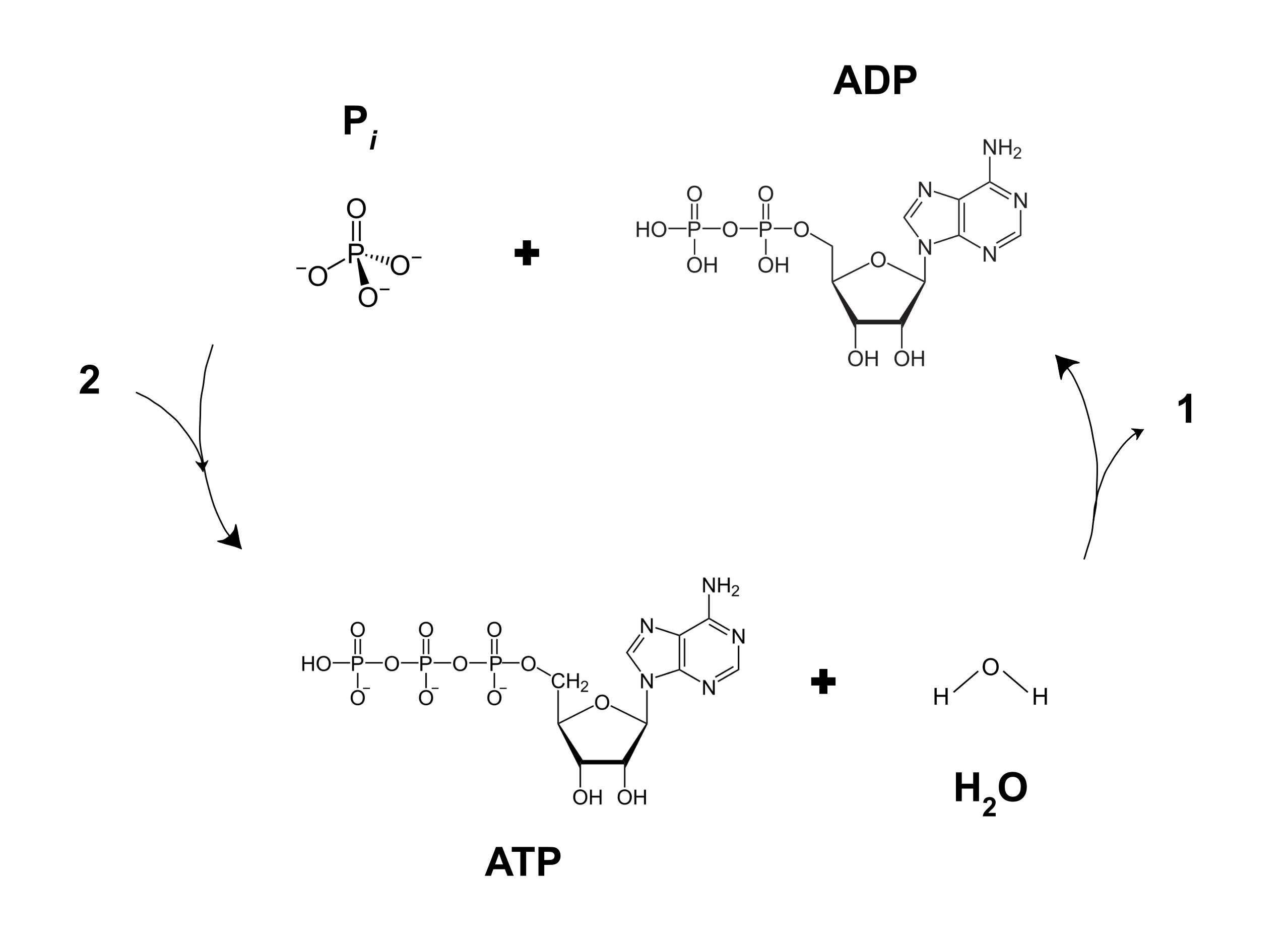
ATP is not a long-term storage molecule. A cell keeps only a small amount at any time and uses it within seconds. Cells constantly rebuild ATP from ADP and phosphate, using energy from food. A person turns over roughly their body weight in ATP each day, which shows how quickly the cycle runs.
Energy coupling
Some reactions need energy to proceed. These are endergonic. Others release energy and are exergonic. A cell links the two in energy coupling, in which the energy released by the breakdown of ATP is used to drive an endergonic reaction. The coupling is often done by transferring the phosphate group to a reactant or a protein, which makes it more reactive or changes its shape.
For example, the sodium-potassium pump from topic 2.8 is phosphorylated by ATP, and that change in shape moves the ions. Muscle contraction, building proteins and copying DNA are all driven by the same strategy. Because ATP can drive so many different processes, it is called the energy currency of the cell.
The reaction that makes ATP is endergonic, so it needs energy too. In cells that energy comes from the breakdown of glucose in respiration and from light in photosynthesis. The overall balance is that more energy is released in food breakdown than is stored in the ATP made, and the rest is lost as heat.
Energy flow in an ecosystem
Light energy is captured by producers, and some is passed along to consumers. At each step, much of the energy is lost as heat, so there is less energy available to higher levels. This explains why food chains are short and why there are fewer top predators than plants. Matter, on the other hand, is cycled, because decomposers return nutrients to the soil.
- Energy: flows one way and leaves as heat.
- Matter: moves in cycles between living and nonliving parts.
- Autotrophs: capture energy from light.
- Heterotrophs: obtain energy from food.
- ATP: short-term energy carrier within a cell.
Worked example: coupling in a pathway
Building a protein from amino acids takes energy, since peptide bond formation does not happen on its own. The cell supplies energy by using ATP. In one common pattern, ATP donates a phosphate to a reactant, making a reactive intermediate. The intermediate then reacts, the phosphate is released and the overall process releases more energy than it takes. The sum of the two steps is favorable even though the building step alone is not.
Compare this with a ball rolling downhill while attached by a rope to a second ball that must go uphill. If the first ball is heavy enough, the second goes up. ATP hydrolysis is the heavy ball. When you explain coupling on the exam, name the reaction that releases energy, the one that needs energy and how ATP links them through the transfer of a phosphate group.
Why it matters for the exam
Know how to describe the ATP cycle and why ATP is a good energy carrier. Questions often ask you to explain how a cell can carry out a reaction that needs energy, and the answer is energy coupling with ATP hydrolysis. Describe both the energy-releasing and energy-requiring reaction.
This topic is a bridge to 3.4 and 3.5, which describe how photosynthesis and respiration make ATP, and to Unit 8, where energy flow through ecosystems is the main theme.
Key takeaways
- Energy flows through living systems, while matter is recycled.
- Autotrophs capture light, and heterotrophs eat other organisms.
- ATP stores usable energy in its phosphate bonds.
- Hydrolysis of ATP gives ADP, a phosphate and energy.
- Energy coupling uses ATP to drive reactions that need energy.
- Cells rebuild ATP constantly from ADP and phosphate.
- Some energy is lost as heat at every transfer.
How this shows up on the exam
- Multiple choice: identify the role of ATP.
- Short answer: explain how coupling drives an endergonic reaction.
- Data question: energy transfer between trophic levels.
- Reasoning skill: explain why energy must be continually supplied.
Common mistakes
- Saying ATP is stored long term. It is used within seconds.
- Saying energy is recycled in ecosystems. Energy flows and matter cycles.
- Saying breaking ATP bonds takes energy. Hydrolysis releases energy that the cell uses.
- Saying heat is a usable form of energy for the cell. It is lost.
Key terms
- ATP
- ADP
- hydrolysis
- energy coupling
- endergonic
- exergonic
- autotroph
- heterotroph
- phosphorylation
- energy currency
- heat
Check yourself
Topic 3.3 quiz
What is the main role of ATP in a cell?