3.4 Photosynthesis
Photosynthesis uses light energy to build sugar from carbon dioxide and water. The light reactions make ATP and NADPH in the thylakoids, and the Calvin cycle uses them in the stroma.
The big picture
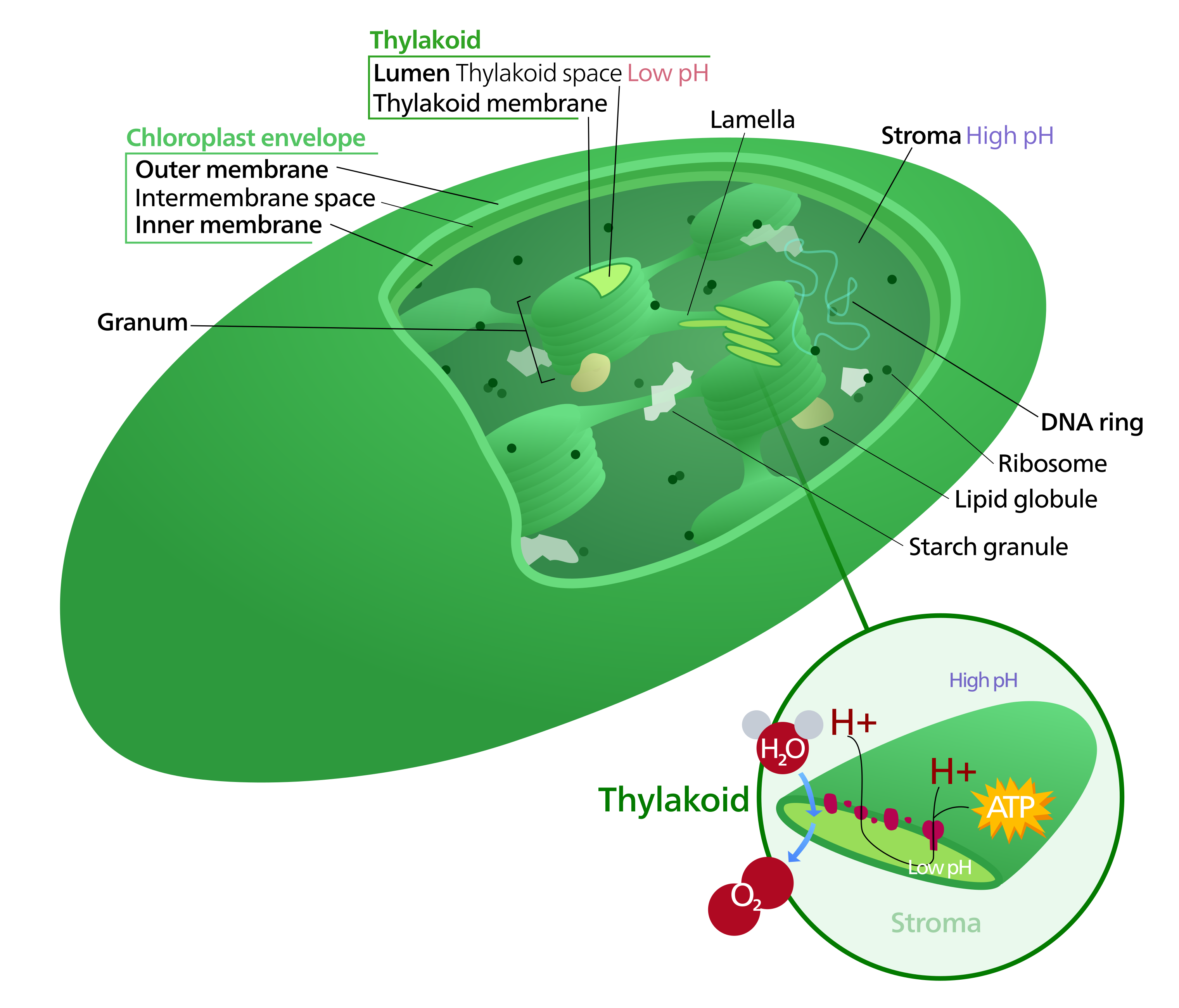
Photosynthesis captures energy from sunlight and stores it in the chemical bonds of sugar. The overall equation is that carbon dioxide and water, in the presence of light, produce glucose and oxygen. The carbon in the sugar comes from carbon dioxide, and the oxygen released comes from water. It takes place in the chloroplast, and it is the source of nearly all the energy in food chains and the oxygen we breathe.
The process has two stages. In the light reactions, light energy is captured and converted to the chemical energy of ATP and NADPH. In the Calvin cycle, the ATP and NADPH are used to build sugar from carbon dioxide. The two stages depend on each other, since the Calvin cycle needs the products of the light reactions, and the light reactions need the ADP and NADP+ returned by the Calvin cycle.
The light reactions
The light reactions happen in the thylakoid membranes. Chlorophyll and other pigments in photosystems absorb light, which excites electrons. The excited electrons are passed along an electron transport chain, and the energy they release is used to pump hydrogen ions, or protons, into the thylakoid space. This builds a proton gradient across the membrane.
The protons then flow back out through the enzyme ATP synthase, and the energy of that flow is used to make ATP from ADP and phosphate. This process is called chemiosmosis. At the end of the chain, the electrons are picked up by NADP+ to make NADPH. The electrons lost from chlorophyll are replaced by splitting water, which releases oxygen as a byproduct.
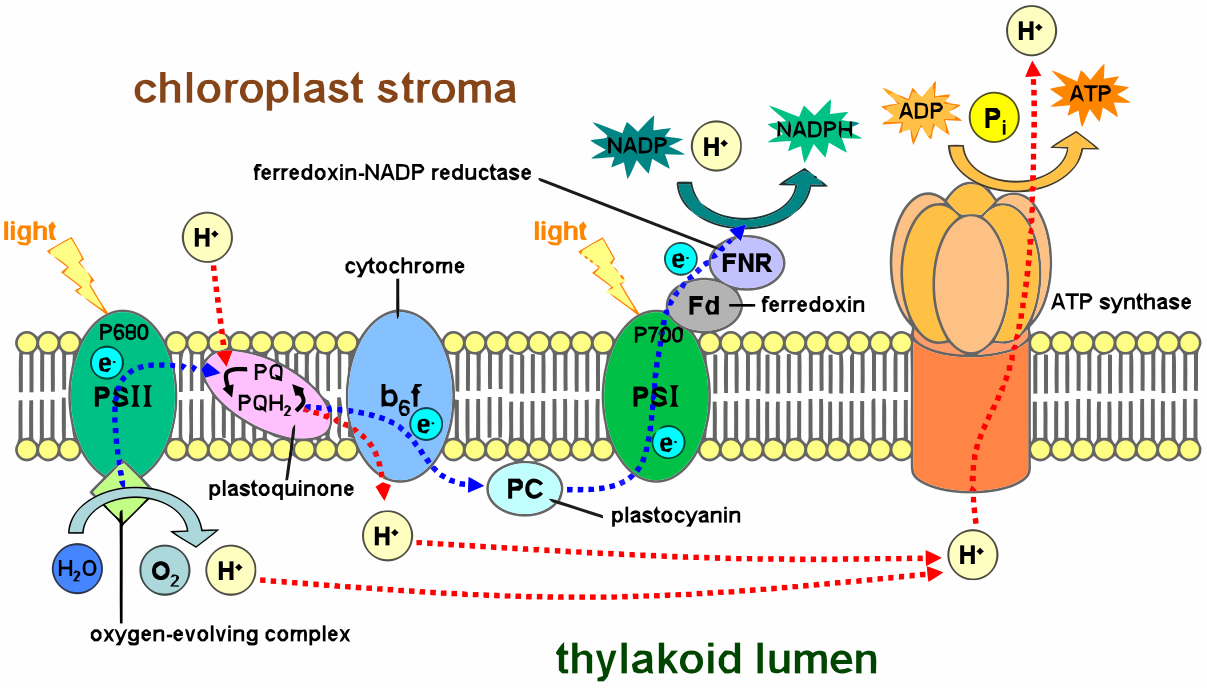
The products are ATP, NADPH and oxygen. The ATP and NADPH carry the captured energy to the next stage, and the oxygen leaves the cell.
The Calvin cycle
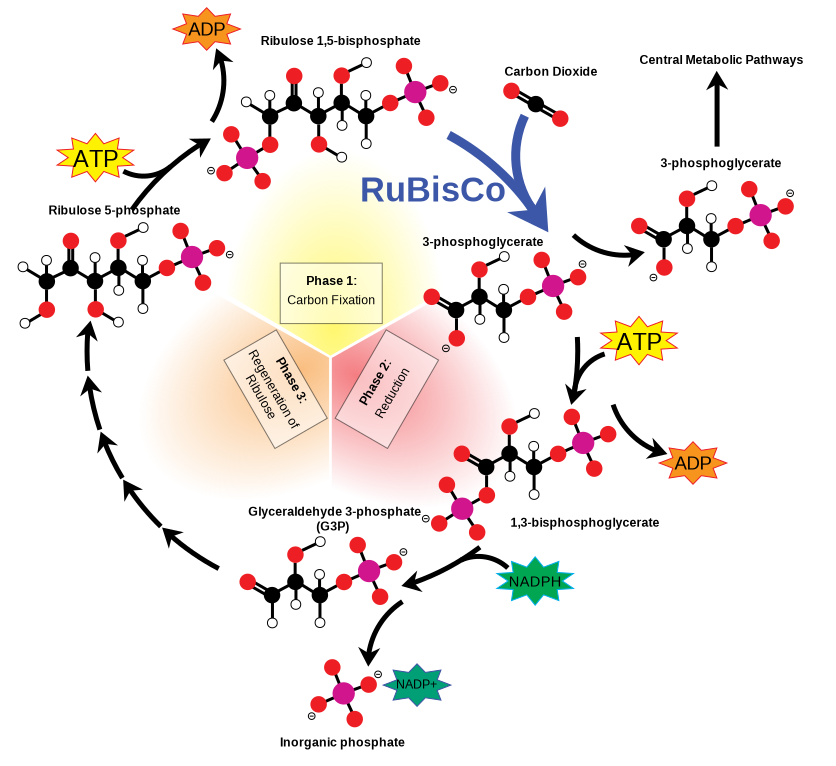
The Calvin cycle takes place in the stroma, the fluid around the thylakoids. Its job is to make sugar from carbon dioxide. In the first step, called carbon fixation, the enzyme rubisco attaches carbon dioxide to a five-carbon molecule called RuBP. The resulting molecule splits into two three-carbon molecules.
The three-carbon molecules are then reduced using the ATP and NADPH from the light reactions, and this forms G3P, a three-carbon sugar. Some G3P leaves the cycle to be turned into glucose and other molecules, and the rest is used to regenerate RuBP so that the cycle can continue. It takes three turns of the cycle to bring in enough carbon for one G3P to leave.
Factors and variations
Photosynthesis speeds up with more light until the pigments are saturated, with more carbon dioxide until the enzymes are saturated, and with warmer temperature until the enzymes denature. In hot dry weather, plants close small pores called stomata to save water, which also keeps carbon dioxide out and oxygen in. Rubisco then sometimes binds oxygen instead of carbon dioxide, which wastes energy in a process called photorespiration.
Some plants have evolved ways to reduce this problem. C4 plants such as corn and sugarcane separate the steps in space, and CAM plants such as cacti open their stomata at night and store carbon dioxide. You do not need all of the details, but you should know that these are adaptations to hot, dry conditions.
Worked example: reading a photosynthesis graph
A graph shows the rate of oxygen release as light intensity rises. At low light the rate climbs steadily, since light is the limiting factor. Then the curve flattens, because something else is limiting, such as carbon dioxide or the number of enzyme molecules. If the experiment were repeated with more carbon dioxide, the flat part would rise to a higher level, but the early part of the curve would stay the same.
Now consider a question where the pigment chlorophyll is separated by paper chromatography and different wavelengths are tested. Chlorophyll absorbs red and blue light strongly and reflects green, so plants look green and the rate of photosynthesis is highest in red and blue light. A graph of rate against wavelength, called an action spectrum, follows the shape of the absorption spectrum. State both the trend and the reason.
Why it matters for the exam
Exam questions ask where each stage happens, what goes in and what comes out. Be exact: water is split in the light reactions and releases oxygen, and carbon dioxide is fixed in the Calvin cycle. A common experiment uses an indicator or a measure of oxygen release to show the rate of photosynthesis at different light levels.
The same ideas of electron transport, proton gradient and ATP synthase appear in respiration in 3.5. Understanding them here will make the next topic easier.
Key takeaways
- Photosynthesis converts light energy into the chemical energy of sugar.
- The light reactions happen in the thylakoids and make ATP, NADPH and oxygen.
- Water is split to replace electrons, and this releases oxygen.
- A proton gradient drives ATP synthase through chemiosmosis.
- The Calvin cycle in the stroma uses ATP and NADPH to make G3P from carbon dioxide.
- Rubisco fixes carbon dioxide.
- Light, carbon dioxide and temperature all affect the rate.
How this shows up on the exam
- Multiple choice: match a product to its stage.
- Short answer: explain how the proton gradient makes ATP.
- Data question: photosynthesis rate against light intensity.
- Reasoning skill: predict the effect of blocking one stage.
Common mistakes
- Saying the oxygen comes from carbon dioxide. It comes from water.
- Saying the Calvin cycle needs no light-reaction products. It needs ATP and NADPH.
- Saying the light reactions happen in the stroma. They happen in the thylakoids.
- Saying photosynthesis happens only during the day for all steps. The Calvin cycle uses stored ATP and NADPH, but depends on the light reactions.
Key terms
- photosynthesis
- chloroplast
- thylakoid
- stroma
- chlorophyll
- photosystem
- electron transport chain
- chemiosmosis
- ATP synthase
- NADPH
- Calvin cycle
- rubisco
- G3P
- stomata
- photorespiration
Check yourself
Topic 3.4 quiz
Where does the oxygen released in photosynthesis come from?