6.1 DNA and RNA Structure
DNA stores genetic information in a double helix, and RNA carries it out. Unit 6 builds on what you learned in 1.6 and shows how structure makes copying and reading possible.
A quick review of the molecules
You met DNA and RNA in topic 1.6, and this topic puts them to work. Both are polymers of nucleotides, and each nucleotide has a sugar, a phosphate and a base. DNA has deoxyribose and the bases A, T, G and C, and RNA has ribose and the bases A, U, G and C. DNA is a double helix of two antiparallel strands, held together by hydrogen bonds between A and T and between G and C.
The key point of Unit 6 is that information is stored in the sequence of bases. A cell reads that sequence to build proteins, and a cell copies it to pass on to daughter cells. Both tasks rely on base pairing: one strand can serve as a template to make a complementary strand. This is the reason the structure of DNA is so important to biology.
Hershey and Chase showed in 1952 that DNA, and not protein, is the genetic material. They used viruses that infect bacteria, labeled the DNA with radioactive phosphorus and the protein with radioactive sulfur, and found that the phosphorus entered the bacteria. Watson and Crick proposed the double helix model in 1953, using X-ray images made by Rosalind Franklin.
Direction and the sugar-phosphate backbone
Each strand has direction. One end, the 5' end, has a free phosphate on the 5' carbon of the sugar. The other end, the 3' end, has a free hydroxyl group on the 3' carbon. The strands in DNA run in opposite directions, which is called antiparallel. Enzymes that build new strands can add nucleotides only to the 3' end, so strands are always made in the 5' to 3' direction.
This single rule explains many features of replication and transcription, which you will see in the next topics. When reading a sequence, always check which end is which. If a strand is written 5' ATGC 3', the complementary strand reads 3' TACG 5', and so it is written 5' CGTA 3' when read in the standard direction.
Differences between prokaryotic and eukaryotic DNA
In prokaryotes, the DNA is usually a single circular chromosome in the nucleoid, with no histone proteins like those in eukaryotes. Many bacteria also have small circular plasmids that carry extra genes, such as antibiotic resistance. In eukaryotes, the DNA is linear and located in the nucleus, wrapped around histones to form chromatin, which packs the long molecule into a small space.
Chromatin can be tightly coiled, called heterochromatin, or loosely coiled, called euchromatin. Genes in tightly coiled DNA are generally not expressed because proteins cannot reach them. This link between packing and expression comes back in 6.5 and 6.6. Mitochondria and chloroplasts have circular DNA of their own, as you learned in 2.10.
Three types of RNA and the central dogma
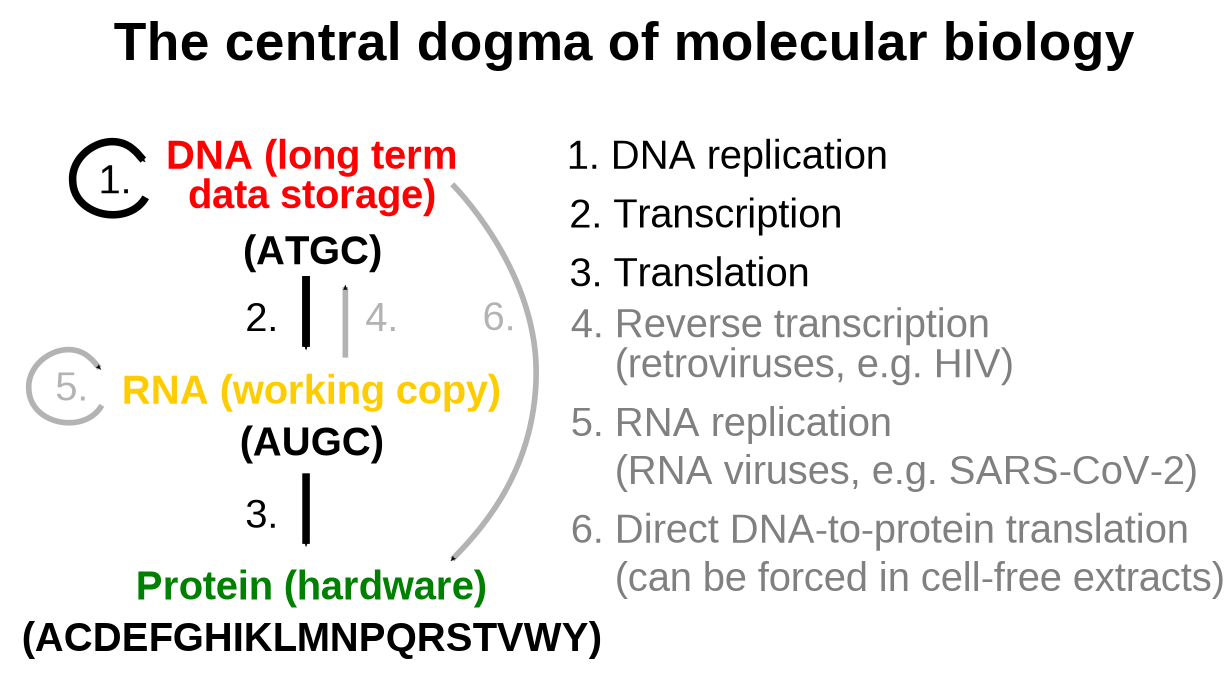
The central dogma says that genetic information flows from DNA to RNA to protein. DNA is copied to DNA by replication, DNA is copied to RNA by transcription and RNA is read to build protein by translation. Three types of RNA take part. mRNA carries the message, tRNA brings amino acids and rRNA is part of the ribosome.
There are exceptions. Some viruses called retroviruses, such as HIV, carry RNA and use the enzyme reverse transcriptase to make DNA from RNA. This does not break the idea that information is stored in nucleic acids, but it shows that the flow can sometimes go in the other direction.
Worked example: base percentages
A scientist analyzes a sample of double-stranded DNA and finds that 28 percent of the bases are guanine. Because G pairs with C, cytosine is also 28 percent. That leaves 44 percent for adenine and thymine together, so each is 22 percent. If the same percentages were found in a sample of RNA, they would not follow the same rule, because RNA is single-stranded and has no obligation to pair A with U or G with C in equal amounts.
This test can be used to identify an unknown sample. If A does not equal T and G does not equal C, the nucleic acid is probably not double-stranded DNA. If it contains uracil, it is RNA. If the sample shows A equal to T but the strands are not paired, the pattern is a coincidence. On the exam, read what kind of molecule it is before you apply the rule.
Why it matters for the exam
Know the structure and direction of nucleic acids well enough to write a complementary sequence quickly and correctly. A common question gives a DNA sequence and asks for the mRNA or the tRNA anticodon. Be careful to replace T with U in RNA, and to keep the direction in mind.
This topic prepares you for replication in 6.2, transcription in 6.3 and translation in 6.4.
Key takeaways
- DNA is a double helix of two antiparallel strands.
- Information is stored in the sequence of bases.
- New strands are built in the 5' to 3' direction.
- Prokaryotic DNA is circular and has no histones, and eukaryotic DNA is linear and wrapped around histones.
- The central dogma goes from DNA to RNA to protein.
- mRNA, tRNA and rRNA have different roles.
- Retroviruses use reverse transcriptase to make DNA from RNA.
How this shows up on the exam
- Multiple choice: write a complementary sequence.
- Short answer: compare prokaryotic and eukaryotic DNA.
- Data question: base percentages.
- Reasoning skill: explain why direction matters.
Common mistakes
- Saying RNA uses thymine. It uses uracil.
- Saying prokaryotes have no DNA. They have a circular chromosome.
- Saying DNA is built from the 3' to the 5' end. Nucleotides are added to the 3' end, so strands grow 5' to 3'.
- Saying the central dogma means information can never go from RNA to DNA. Retroviruses do it.
Key terms
- DNA
- RNA
- double helix
- antiparallel
- 5' end
- 3' end
- histone
- chromatin
- plasmid
- central dogma
- mRNA
- tRNA
- rRNA
- reverse transcriptase
- retrovirus
Check yourself
Topic 6.1 quiz
A DNA template strand reads 3' TACGGA 5'. What is the mRNA sequence made from it?