6.5 Regulation of Gene Expression
Cells control which genes are on. In bacteria, operons switch groups of genes together, and in eukaryotes transcription factors and DNA packing do the job.
Why cells regulate genes
A cell carries all of its genes, but it does not need all the proteins at once. Making unneeded proteins wastes energy and materials. Cells therefore control gene expression, deciding which genes are transcribed and how much. Regulation usually happens at the start of transcription, because blocking it is the most efficient place to save resources.
Control is done by regulatory proteins that bind to DNA near a gene. Some proteins are repressors, which block transcription, and some are activators, which help RNA polymerase bind. The regulatory proteins respond to signals from inside and outside the cell, such as nutrients or hormones, which links this topic to the signaling you studied in Unit 4.
The result is that the amount of each protein matches what the cell needs at that moment, and that different cell types can switch on different groups of genes.
Operons in bacteria
Bacteria often group genes that work together into an operon, which is transcribed as a single unit from one promoter. An operon has a promoter, an operator where a repressor can bind, and the structural genes. When a repressor is bound to the operator, it blocks RNA polymerase and the genes are off.
The lac operon controls lactose digestion in E. coli. When there is no lactose, the repressor sits on the operator and the genes are off. When lactose is present, a form of it called allolactose binds to the repressor and changes its shape, so it falls off the operator. RNA polymerase can then transcribe the genes for the enzymes that digest lactose. The lac operon is an inducible operon: it is usually off and is turned on by the presence of lactose.
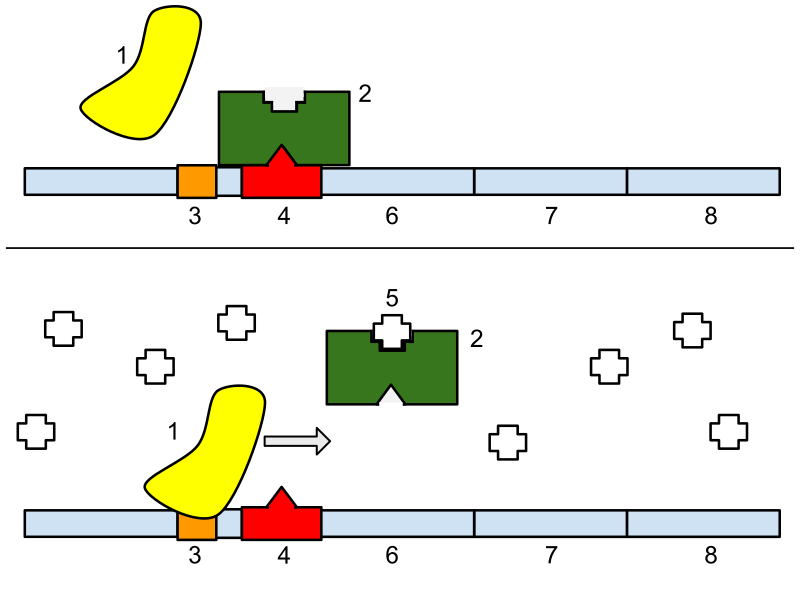
The trp operon controls the making of the amino acid tryptophan. It is usually on, because the cell needs tryptophan. When tryptophan is plentiful, it binds to the repressor, which then binds to the operator and turns the genes off. This is a repressible operon. It is a good example of negative feedback, since the product shuts down its own production.
Regulation in eukaryotes
Eukaryotes have more layers of control. DNA is wrapped around histones, and tightly packed chromatin cannot be transcribed. Chemical tags change the packing. Adding acetyl groups to histones loosens chromatin and turns genes on, and adding methyl groups to DNA usually turns genes off. These changes are called epigenetic because they affect expression without changing the sequence, and some can be passed on when cells divide.
At the promoter, transcription factors are proteins that help RNA polymerase bind. Enhancers are DNA sequences, often far from the gene, where activators bind and loop the DNA to boost transcription. Many genes need a combination of factors, which allows precise control. A single transcription factor can turn on many genes, which is how a signal like a steroid hormone can change many things in a cell.
Control also happens after transcription. Alternative splicing, the breakdown rate of mRNA and small RNA molecules that block translation, called microRNAs, all adjust how much protein is made.
Quick reference
- Promoter: where RNA polymerase binds.
- Operator: where a repressor binds in an operon.
- Inducible operon: normally off, turned on by a molecule such as lactose.
- Repressible operon: normally on, turned off by a molecule such as tryptophan.
- Transcription factor: helps RNA polymerase bind in eukaryotes.
- Epigenetic changes: acetyl or methyl tags that change expression.
Worked example: the lac operon in four conditions
Consider four conditions in E. coli. With no lactose, the repressor binds the operator and the genes are off. With lactose present, allolactose binds the repressor, which releases the operator, and the genes are transcribed. If the repressor gene is mutated so that it cannot bind the operator, the genes are on all the time, even without lactose. If the operator is mutated so that the repressor cannot bind, the same result occurs.
A fifth case is a mutation in the repressor that prevents it from binding allolactose. Now the repressor stays on the operator all the time, and the genes are off even when lactose is present. Cells with this mutation cannot use lactose. Setting out each case in a small table of lactose, repressor state and gene state prevents confusion and is an efficient way to answer these questions.
Why it matters for the exam
Operon questions usually show a diagram or describe a mutation and ask what happens to gene expression. For example, if the repressor cannot bind the operator, the genes are always on. If the operator cannot bind the repressor, the same is true. If the repressor cannot be released by lactose, the genes are always off. Work through the problem step by step, with the repressor, the operator and the inducer.
This topic leads to 6.6, which explains how cells with the same DNA become different types, and it connects to Unit 4 on feedback and to Unit 7 on how regulatory changes can drive evolution.
Key takeaways
- Cells regulate gene expression, mostly at transcription.
- An operon is a group of genes under one promoter and operator.
- The lac operon is inducible, and lactose turns it on.
- The trp operon is repressible, and tryptophan turns it off.
- Eukaryotes use transcription factors, enhancers and chromatin changes.
- Acetyl groups loosen chromatin, and methyl groups on DNA often silence genes.
- Epigenetic changes affect expression without changing the DNA sequence.
How this shows up on the exam
- Multiple choice: predict the effect of an operon mutation.
- Short answer: explain how lactose turns on the lac operon.
- Diagram question: label an operon.
- Reasoning skill: compare regulation in bacteria and eukaryotes.
Common mistakes
- Saying the lac operon is on without lactose. It is off until lactose is present.
- Saying the repressor binds to the promoter. It binds to the operator.
- Saying epigenetic changes alter the DNA sequence. They do not.
- Saying only prokaryotes regulate genes. Eukaryotes do it too, with more levels.
Key terms
- gene expression
- operon
- promoter
- operator
- repressor
- activator
- lac operon
- trp operon
- inducible
- repressible
- transcription factor
- enhancer
- epigenetic
- acetylation
- methylation
- microRNA
Check yourself
Topic 6.5 quiz
In the lac operon, a mutation prevents the repressor from binding to the operator. What is the most likely result?