6.4 Translation
Translation reads the mRNA code in groups of three bases and builds a polypeptide at the ribosome. tRNA molecules match each codon with the right amino acid.
The genetic code
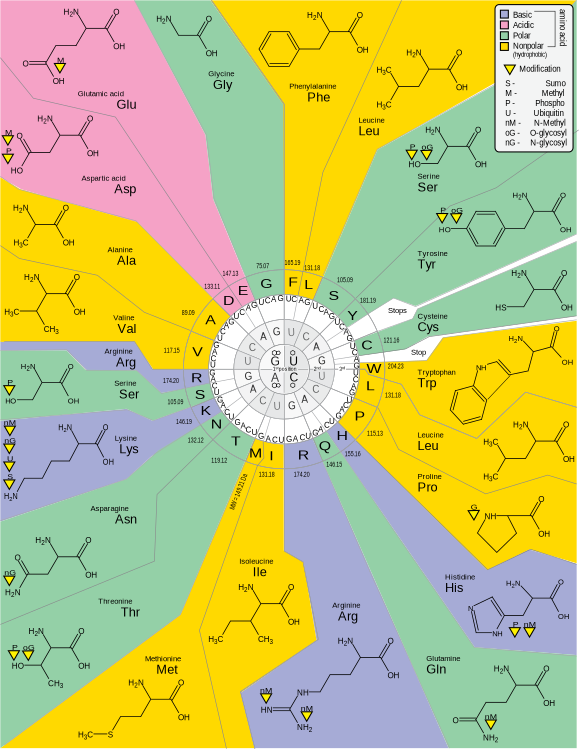
The mRNA sequence is read in groups of three bases called codons. Each codon stands for one amino acid, or for a signal to start or stop. There are 64 possible codons and only 20 amino acids, so the code is redundant, meaning most amino acids have more than one codon. The code is universal, meaning that almost all organisms use the same code, which is strong evidence for common ancestry.
The codon AUG is the start codon and codes for methionine, so every new protein begins with it. Three codons, UAA, UAG and UGA, are stop codons that signal the end. The codon table is given on the exam in some versions of the course, and you should know how to read it. You find the first base on the side, the second across the top and the third on the other side.
The players: ribosomes and tRNA
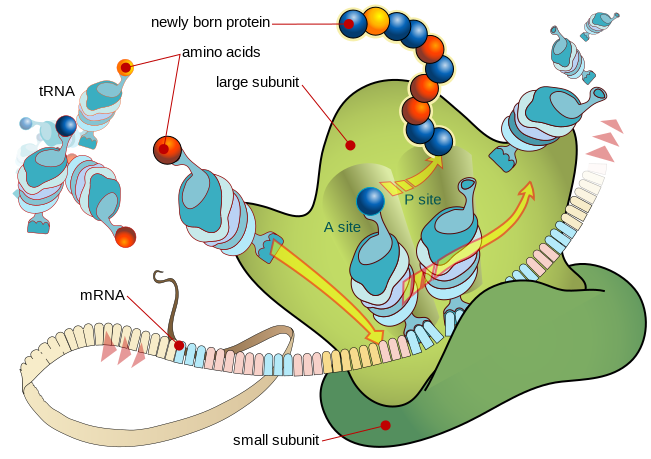
The ribosome is the site of translation. It is made of rRNA and proteins, in a large subunit and a small subunit. It has three sites: the A site, where a new tRNA arrives, the P site, where the growing chain is held, and the E site, where empty tRNA exits. Ribosomes can be free in the cytoplasm or attached to the rough ER.
Transfer RNA, or tRNA, is the adapter. One end carries a specific amino acid and the other has an anticodon, three bases that pair with a codon on the mRNA. Enzymes called aminoacyl-tRNA synthetases attach the correct amino acid to each tRNA, which is important for accuracy. The pairing between codon and anticodon is what links the base code to the amino acid code.
The stages of translation
In initiation, the small ribosomal subunit binds the mRNA and finds the start codon AUG. A tRNA with the anticodon UAC and carrying methionine pairs with it. The large subunit then joins. In elongation, a tRNA with the matching anticodon enters the A site, and the ribosome forms a peptide bond between the amino acids in the P and A sites. The ribosome then moves along by one codon, which is called translocation. The tRNA in the P site moves to the E site and leaves, and the one in the A site moves to the P site.
In termination, the ribosome reaches a stop codon. There is no tRNA for a stop codon. Instead, a protein called a release factor binds, and the polypeptide is released. The ribosome subunits come apart. The finished chain then folds into its shape, and it may be modified or sent to the Golgi, as you saw in 2.1.
Using the code in problems
To find the amino acid sequence from DNA, first write the mRNA, then split it into codons starting with AUG, and then use the table. For example, a template reading 3' TACCCGATT 5' gives mRNA 5' AUGGGCUAA 3'. The codons are AUG, GGC and UAA, so the protein is methionine, glycine and then stop.
Remember that tRNA anticodons are complementary to the mRNA codons. An mRNA codon of GGC is matched by the anticodon CCG. Also note that polypeptides begin at the amino end and grow toward the carboxyl end, as the ribosome moves along the mRNA from the 5' end to the 3' end.
Worked example: translating and testing a mutation
Take the mRNA 5' AUG CCU GAA UUU UAA 3'. Using the genetic code, the protein is methionine, proline, glutamic acid, phenylalanine and then stop, so it is four amino acids long. Now change the third codon from GAA to GAG. Both code for glutamic acid, so the protein is the same: a silent mutation. Change it to UAA instead, and the protein stops after proline, giving a very short chain: a nonsense mutation.
Now delete the first U of the third codon. The reading frame shifts, and the message becomes AUG CCU AAU UUU AA, which gives methionine, proline, asparagine, phenylalanine and an incomplete codon. This frameshift changes every amino acid after the deletion. Working through each version codon by codon is the safest method, and the answers will show clearly why a frameshift is usually more damaging than a single substitution.
Why it matters for the exam
Translation questions test the order of steps, the role of each RNA and your ability to use the code. A typical problem gives a mutation and asks for the effect on the protein. You can also be asked why a change in the third base of a codon often has no effect. This is due to redundancy.
This topic completes the central dogma. Topic 6.5 shows how the cell controls which genes are used, and 6.7 shows what happens when the sequence changes.
Key takeaways
- The genetic code is read in three-base codons.
- AUG is the start codon, and UAA, UAG and UGA are stop codons.
- The code is redundant and nearly universal.
- tRNA anticodons pair with mRNA codons and carry specific amino acids.
- The ribosome has A, P and E sites.
- Translation goes through initiation, elongation and termination.
- Peptide bonds join the amino acids.
How this shows up on the exam
- Multiple choice: translate an mRNA into amino acids.
- Short answer: explain the role of tRNA.
- Reasoning skill: explain why the code is redundant.
- Data question: effect of a base change on the protein.
Common mistakes
- Saying the anticodon is on the mRNA. It is on the tRNA.
- Saying there is a tRNA for stop codons. A release factor is used.
- Saying one codon codes for several amino acids. The code is redundant in the other direction.
- Saying the ribosome moves along DNA. It moves along mRNA.
Key terms
- translation
- codon
- anticodon
- start codon
- stop codon
- redundant
- universal
- ribosome
- A site
- P site
- E site
- peptide bond
- release factor
- polypeptide
- tRNA
Check yourself
Topic 6.4 quiz
An mRNA codon is 5' GCA 3'. What is the anticodon of the tRNA that pairs with it?