6.3 Transcription and RNA Processing
Transcription copies a gene into RNA using RNA polymerase. In eukaryotes the RNA is then processed before it leaves the nucleus.
Transcription: DNA to RNA
Transcription makes an RNA copy of a gene. The enzyme RNA polymerase binds to a region of DNA called the promoter, which marks the start of a gene. It unwinds the DNA, reads one strand, the template strand, and builds an RNA strand by adding RNA nucleotides complementary to the template. It adds them to the 3' end, so the RNA grows 5' to 3'. Unlike DNA polymerase, RNA polymerase does not need a primer.
In RNA, A on the template is paired with U, and the rest pair as usual. The RNA is therefore a copy of the other DNA strand, the coding strand, with U in place of T. When the polymerase reaches a terminator sequence, it releases the RNA, and the DNA closes up again. Many RNA molecules can be made from one gene at the same time.
Transcription is how a cell decides which proteins to make. A cell does not transcribe every gene. Which genes are used depends on the signals the cell receives, which you will study in 6.5.
The three stages
- Initiation: RNA polymerase binds the promoter, and in eukaryotes this requires transcription factors.
- Elongation: the polymerase moves along the template and builds the RNA in the 5' to 3' direction.
- Termination: the polymerase reaches the terminator and releases the new RNA.
In prokaryotes, there is no nucleus, so translation can begin on the mRNA while it is still being made. This allows a fast response to changes in the environment. In eukaryotes, transcription takes place in the nucleus and translation in the cytoplasm, so the mRNA must travel between them.
Processing the RNA in eukaryotes
In eukaryotes, the first RNA made, the pre-mRNA, is not ready for use. Three changes occur in the nucleus. A 5' cap, a modified guanine nucleotide, is added to the start. A poly-A tail, a string of about 100 to 250 adenine nucleotides, is added to the 3' end. These help the mRNA leave the nucleus, protect it from enzymes that break it down and help the ribosome attach.
The third change is splicing. Genes in eukaryotes contain exons, which code for protein, and introns, which are noncoding regions in between. A complex called the spliceosome removes the introns and joins the exons together. The result is a shorter, mature mRNA that goes out through a nuclear pore.
Alternative splicing allows one gene to make several different proteins, because exons can be joined in different combinations. This is one reason humans, with about 20,000 genes, make far more than 20,000 different proteins.
Comparing prokaryotes and eukaryotes
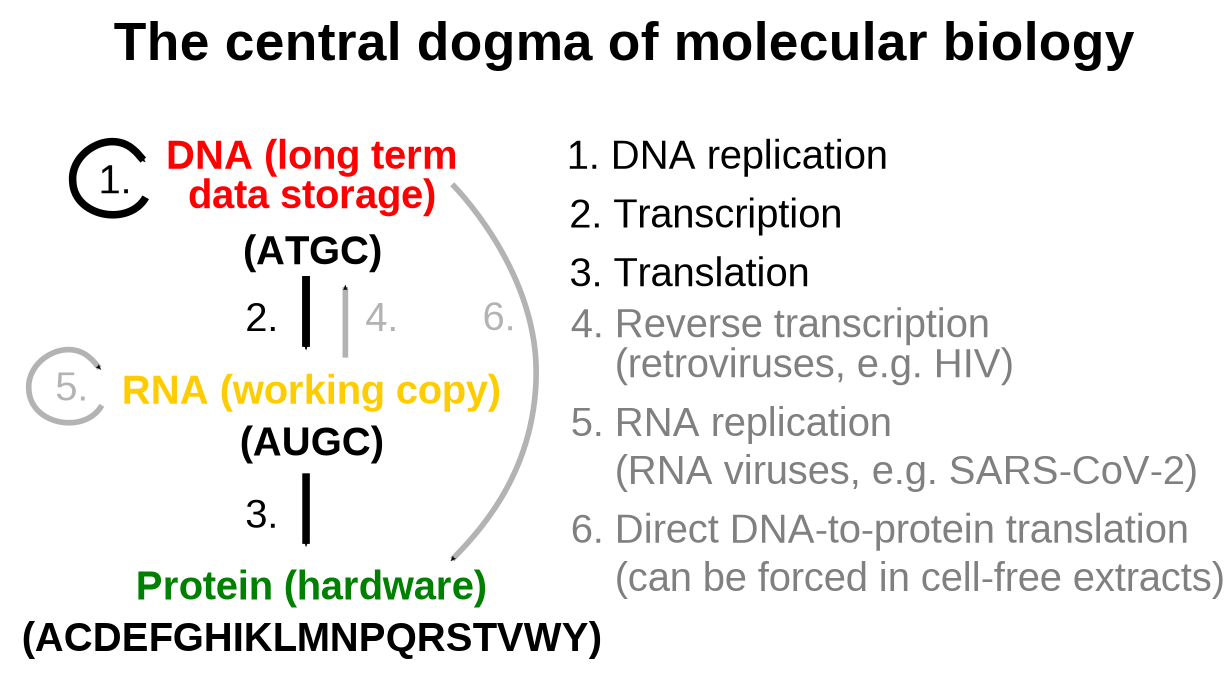
Worked example: from gene to mature mRNA
A eukaryotic gene has three exons and two introns. RNA polymerase transcribes the whole region into a pre-mRNA, including both introns. In the nucleus, a 5' cap is added to the front and a poly-A tail to the end. The spliceosome then removes the two introns and joins the three exons into a continuous message. The mature mRNA is shorter than the gene, and it exits through a nuclear pore.
Now picture a mutation at the junction between an intron and the next exon that prevents splicing at that site. The intron stays in the mRNA, and the ribosome reads intron sequence as if it were coding. That usually adds extra amino acids or creates a premature stop codon, so the protein is faulty. Splicing mutations are a recognized cause of genetic disease.
A related example involves alternative splicing. If the cell skips exon 2 in one tissue and includes it in another, the same gene gives two versions of a protein with different functions. That is one reason that the number of proteins in a cell exceeds the number of genes. When you read a diagram, trace the pre-mRNA to the mature mRNA and mark what was removed and what was added.
Why it matters for the exam
Typical questions give a DNA template and ask for the RNA, or ask what happens if a promoter or splicing is changed. A mutation in a promoter can stop transcription of the gene, and a mutation at a splice site can leave in an intron and change the protein. Learn the role of each processing step.
Transcription links to gene regulation in 6.5 and 6.6, since the cell controls how much RNA is made, and to translation in 6.4.
Key takeaways
- RNA polymerase transcribes a template strand into RNA, 5' to 3'.
- The promoter marks where transcription starts, and the terminator marks where it stops.
- RNA polymerase does not need a primer.
- Eukaryotic pre-mRNA gets a 5' cap and a poly-A tail.
- Introns are removed and exons joined by splicing.
- Alternative splicing lets one gene make several proteins.
- In prokaryotes, translation can begin before transcription ends.
How this shows up on the exam
- Multiple choice: give the RNA from a template.
- Short answer: explain the roles of the cap and tail.
- Reasoning skill: predict the effect of a promoter mutation.
- Diagram question: identify exons and introns.
Common mistakes
- Saying RNA polymerase needs a primer. It does not.
- Saying introns code for protein. Exons do.
- Saying prokaryotes splice their mRNA. They generally do not have introns.
- Saying the RNA is a copy of the template strand. It is complementary to it.
Key terms
- transcription
- RNA polymerase
- promoter
- terminator
- template strand
- pre-mRNA
- 5' cap
- poly-A tail
- intron
- exon
- splicing
- alternative splicing
- spliceosome
Check yourself
Topic 6.3 quiz
A mutation prevents the addition of a poly-A tail to a eukaryotic mRNA. What is the most likely result?