6.2 Replication
DNA replication makes a copy of the genome before a cell divides. Each new molecule has one old strand and one new strand, and enzymes build it in the 5' to 3' direction.
Semiconservative replication
Before a cell divides, it must copy all its DNA so that each daughter cell gets a full set. The method is semiconservative: each new DNA molecule has one original strand and one newly made strand. Meselson and Stahl showed this in 1958 using bacteria grown in heavy nitrogen and then moved to light nitrogen. After one round, all DNA was intermediate in density, which fit only the semiconservative model.
The pairing rules make this possible. Because A pairs with T and G pairs with C, each old strand can act as a template for a new complementary one. This is why DNA is copied accurately. The error rate is very low, about one mistake in a billion bases, thanks to the proofreading described below.
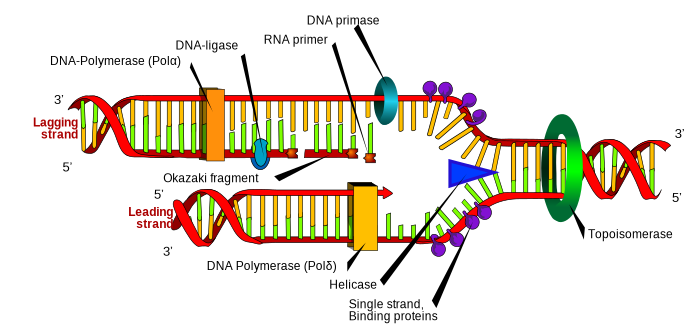
The enzymes at the replication fork
Replication begins at sites called origins of replication. Bacteria have one origin on their circular chromosome, while eukaryotes have many origins on each chromosome so that large genomes can be copied in a reasonable time. At each origin, the DNA opens to make a Y-shaped replication fork.
Helicase unwinds the double helix by breaking the hydrogen bonds between strands. Single-strand binding proteins keep the strands apart. Topoisomerase relieves the twisting tension ahead of the fork. Primase makes a short RNA primer, because DNA polymerase cannot start a strand on its own and needs a 3' end to add to. DNA polymerase III adds nucleotides to the 3' end of the primer, building the new strand. Each incoming nucleotide pairs with the template base.
DNA polymerase also proofreads. If it adds a wrong base, it can back up, remove it and try again. Later, DNA polymerase I replaces the RNA primers with DNA, and DNA ligase joins the pieces together by sealing the gaps in the backbone.
Leading and lagging strands
DNA polymerase can only build in the 5' to 3' direction, but the two template strands run in opposite directions. At the fork, one template runs so that the new strand can be built continuously toward the fork. This is the leading strand. The other new strand has to be built in short pieces, away from the fork, each started by a new primer. These pieces are called Okazaki fragments, and this is the lagging strand.
The fragments are later joined by ligase. This explains why the lagging strand is made in a discontinuous way and why ligase is needed. If you remember only one thing about this topic, remember that polymerase works one direction only, and the rest follows.
Telomeres and repair
Eukaryotic chromosomes are linear, so the very ends cannot be fully copied on the lagging strand, because the last primer cannot be replaced. Each round of replication shortens the chromosome ends a little. The ends have repeated, non-coding sequences called telomeres that act as a buffer, so no genes are lost. The enzyme telomerase extends the telomeres in cells such as stem cells and germ cells, and also in most cancer cells, which helps them divide without limit.
Cells also have repair systems. Mismatch repair fixes errors the polymerase missed, and excision repair cuts out damaged DNA, such as that caused by ultraviolet light, and fills the gap. People who lack these repair systems have a very high risk of cancer. Replication, proofreading and repair together keep mutations rare.
Worked example: a missing enzyme
Suppose a mutant bacterium has a defective DNA ligase. Replication begins normally. Helicase opens the fork, primase lays primers and polymerase builds both strands. On the leading strand, the new DNA is continuous, so the cell copies that strand without trouble. On the lagging strand, the Okazaki fragments are made but never joined, so the new DNA has many nicks. The chromosome is fragile, and the cell will likely die or be unable to divide properly.
Now suppose the mutant lacks helicase instead. The DNA never opens, so no new strand can start at all. If it lacks primase, polymerase has no 3' end to extend and cannot begin. Each missing enzyme has its own signature failure. In an exam answer, name the enzyme's job, say which step fails and describe what happens to each strand.
Why it matters for the exam
Questions may ask you to name an enzyme from its job, explain why the lagging strand is built in fragments or predict the result of a missing enzyme. Without helicase, the DNA would not open. Without ligase, the fragments would stay separate. Without primase, the polymerase could not start.
Replication ties into the cell cycle in 4.5, because it happens in S phase, and into mutation in 6.7. It also helps with biotechnology in 6.8, where PCR is a copy of replication in a tube.
Key takeaways
- Replication is semiconservative: each new molecule has one old and one new strand.
- Helicase unwinds the DNA, and primase adds an RNA primer.
- DNA polymerase adds nucleotides only to the 3' end, so strands grow 5' to 3'.
- The leading strand is built continuously and the lagging strand in Okazaki fragments.
- Ligase joins the fragments.
- Polymerase proofreads and repair systems fix other errors.
- Telomeres protect chromosome ends, and telomerase extends them.
How this shows up on the exam
- Multiple choice: match an enzyme to its job.
- Short answer: explain Okazaki fragments.
- Data question: Meselson and Stahl results.
- Reasoning skill: predict the effect of a missing enzyme.
Common mistakes
- Saying replication is conservative. It is semiconservative.
- Saying polymerase can start a strand with no primer. It needs a primer.
- Saying both strands are built continuously. The lagging strand is built in pieces.
- Saying helicase joins fragments. Ligase does.
Key terms
- replication
- semiconservative
- origin of replication
- replication fork
- helicase
- primase
- primer
- DNA polymerase
- leading strand
- lagging strand
- Okazaki fragment
- ligase
- proofreading
- telomere
- telomerase
Check yourself
Topic 6.2 quiz
Which enzyme joins Okazaki fragments on the lagging strand?